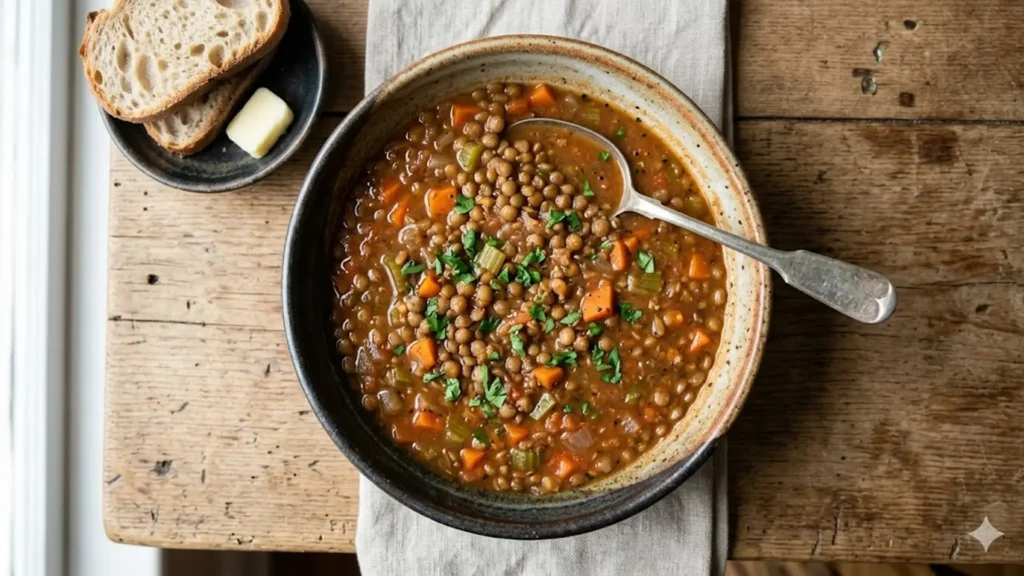
Slow cooker lentil soup is the most forgiving pot of food I make, and it is also the one most people accidentally ruin. The short version: use brown or green lentils for a soup that holds its shape, cook on low for 6 to 8 hours or high for 3 to 4, add acidic ingredients like tomatoes and lemon only in the final 30 to 45 minutes, and salt the pot after the lentils have softened, not before. Get those rules right and 1.5 cups of dried lentils turn into eight bowls of something that tastes like you stood over it all day.
That is the whole method in one breath, and it is the answer most recipe pages bury under photos. The rest of this guide explains the why behind each rule, gives you a per-variety cook chart, and walks through fixing a pot that came out gritty, mushy, or bland. If you only remember one thing, remember that acid and salt go in late.
I have made this soup on Sundays for years, usually while doing laundry in the next room. The slow cooker does the patient work. What follows is everything I learned the hard way about which lentil to reach for, how long to actually run the machine, and how to fix a pot that went gritty or turned to mush.
Most of the recipes you will find online get the basics right and then stop. They hand you a ratio and a cook time and move on to the photos. What they rarely explain is why the same recipe gives one cook a silky bowl and another cook a pot of chalky pebbles. The answer is almost never the recipe. It is the lentil age, the water, the order things go in the pot, and when the salt and acid show up. Once you understand those variables, you stop following recipes and start cooking, which is a much better place to be.
Which Lentil You Pick Changes Everything
Most recipes online tell you to grab “brown or green lentils” and stop there. That advice is fine until you want a specific texture. The variety you choose is the single biggest lever you have, bigger than the spices, bigger than the broth brand. Here is how I think about it when I open the pantry.
| Lentil | Texture in soup | Slow cooker time |
|---|---|---|
| Brown | Soft but structured, classic soup body | Low 6 to 8 h, High 3 to 4 h |
| Green | Firm, stays whole, slight bite | Low 7 to 9 h, High 4 to 5 h |
| Red | Dissolves into a creamy, thick base | Low 4 to 5 h, High 2 to 3 h |
| Black (beluga) | Holds shape best, glossy, premium look | Low 7 to 8 h, High 4 h |
I default to brown when I want a soup people recognize as lentil soup. When I want every spoonful to have intact little discs, I reach for green or French Puy lentils, and I lean on my notes for cooking green lentils so they stay whole rather than blowing out their skins. Red and yellow lentils are a different animal. They are not really a soup-that-holds-its-shape lentil at all. They break down on purpose, which is why a red lentil pot reads as a thick dal-style puree instead of a brothy bowl.
This per-variety chart is the piece most popular recipes leave out. The big sites tell you green or brown and call it done, with red lentils dismissed in a single line as something that falls apart. That is not wrong, but it is not enough to actually plan a bowl. Beluga lentils hold their shape better than any of them and give a soup a glossy, almost caviar-like look, which is worth knowing if you are cooking for guests. Knowing the trade each variety makes is the difference between a soup you hoped for and the soup you got.
The Build: Ratios That Actually Fill the Pot
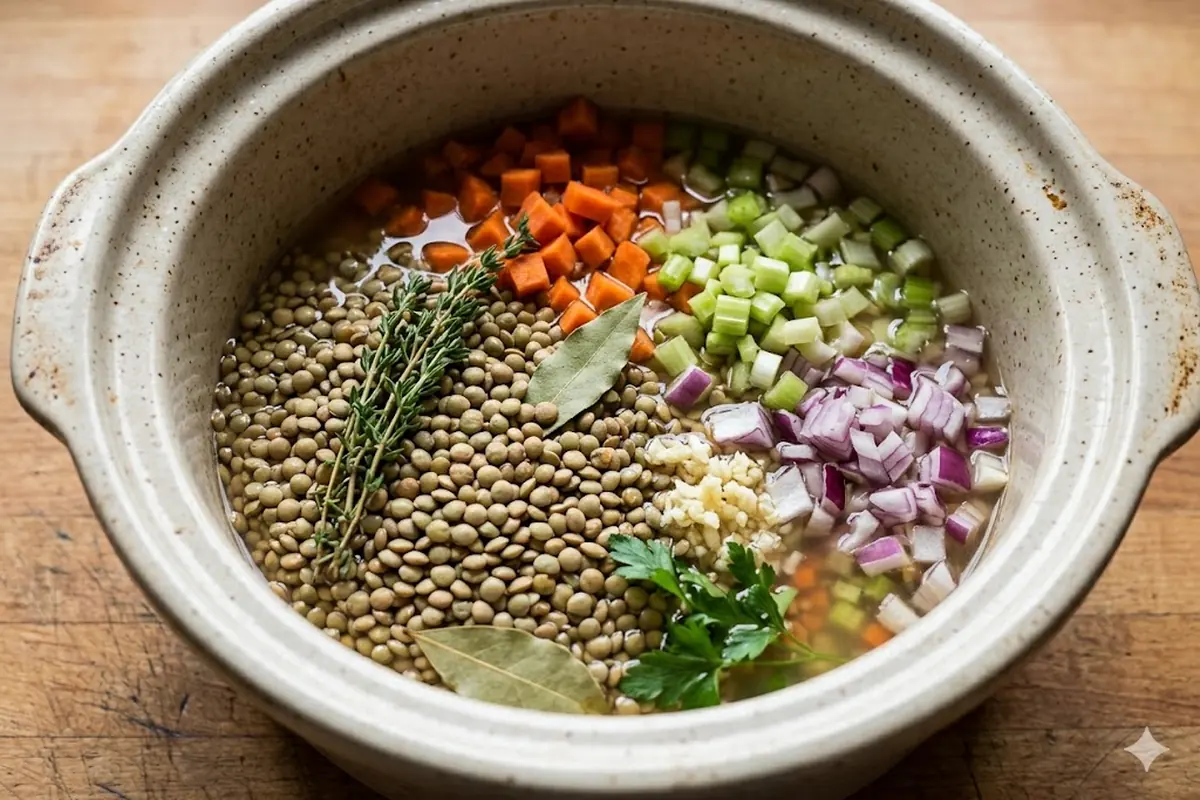
A reliable starting ratio is 1.5 cups dried lentils to 8 cups of vegetable broth. That gives you a soup, not a stew. If you like it thick enough to stand a spoon in, drop the broth to 6 cups. Go the other way to 9 cups if you want it loose and sippable. Lentils drink a surprising amount of liquid as they sit, so a soup that looks perfect at hour four will look like wet gravel by day three in the fridge. That is normal. You thin it on reheat.
My base layer almost never changes: one diced onion, two carrots, two ribs of celery, four cloves of garlic, a couple of bay leaves, a teaspoon of cumin, and a teaspoon of smoked paprika. I add the lentils and broth, set the machine, and walk away. The vegetables soften into the background and the lentils carry the bowl. If you want a heartier protein spread across the week, this soup slots neatly into a rotation alongside dishes built from properly prepped chickpeas, which freeze and reheat on a similar schedule.
One thing worth measuring rather than eyeballing is the lentil-to-vegetable balance. I keep the chopped vegetables to roughly two cups total against my 1.5 cups of dried lentils. Go much heavier on vegetables and the soup starts to taste like minestrone with lentils as an afterthought. Go lighter and it reads as a plain bowl of legumes. That two-to-one-and-a-half ratio keeps the lentils as the star while the carrots and celery do the supporting work. The broth quality matters more than people admit too. A flat, salty boxed broth makes a flat, salty soup, so I use a low-sodium vegetable broth and build the seasoning myself, which also lets me control the salt timing that I will get to in a moment.
Texture preference should drive your liquid choice from the start. If you grew up on thick, almost stew-like lentil soup that a spoon stands in, commit to 6 cups of broth and accept that the leftovers will be nearly solid. If you want a brothy bowl you can sip, go to 9 cups and know it will still thicken overnight. There is no wrong answer, only a choice you should make before the lid goes on rather than discover hours later.
Building Flavor When the Heat Is Low and Slow
A slow cooker is gentle, which is its gift and its catch. Gentle heat means nothing scorches and the lentils cook evenly, but it also means you never get the deep browning that a hot pan gives you. There is no Maillard reaction happening in a covered crock at 200 degrees. So if you dump raw onion, raw garlic, and dry spices into the pot and walk away, you can end up with a soup that tastes flat even though the texture is perfect. The flavor is thin, not wrong, just thin.
I get around this in one of two ways. On a lazy day, I lean hard on bloomed spices, meaning I warm the cumin, paprika, and a pinch of red pepper in a dry skillet for about 60 seconds until they smell toasty, then scrape them into the pot. Blooming wakes up the oils in dried spices and gives you most of the depth that browning would, with almost no extra work. On a day when I care more, I take five minutes to saute the onion, carrot, celery, and garlic in a little oil until the edges color, then add them to the crock. That single step is the difference between a soup that tastes fine and one people ask about.
Salt-free seasoning matters too. A teaspoon of smoked paprika does more for a lentil soup than almost anything else, because the smoke reads as savory depth that vegan soups often lack. A spoonful of tomato paste, stirred in near the end so the acid does not interfere early, adds a glutamate-rich backbone. And a small splash of soy sauce or tamari at the finish brings umami that makes the whole bowl taste rounder. None of these are exotic, and all of them stack.
The Two Timing Rules Nobody Explains Well
Here is where the average recipe leaves money on the table. Two ingredients can sabotage your lentils no matter how long you cook, and both come down to timing.
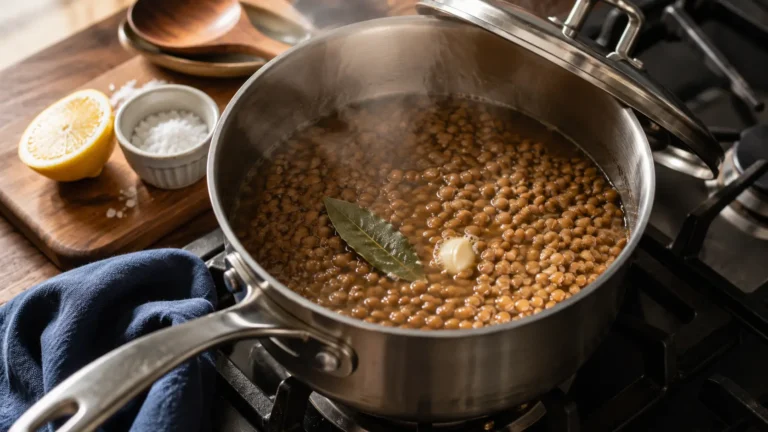
Acid is the first. Tomatoes, lemon juice, and vinegar all firm up the skins of lentils and slow their softening. The pectin and the lentil skin both tighten in an acidic environment, so a pot that should have been done at hour six is still chalky at hour eight. The fix is simple. Hold all acidic ingredients until the final 30 to 45 minutes. Stir in diced tomatoes or a squeeze of lemon at the end, let it warm through, and the lentils stay tender while the brightness still lands.
Salt is the second, and it is the one people argue about. Salt does not turn lentils to concrete the way old kitchen lore claims, but it does slow softening enough to matter over a long slow cook. I salt after the lentils have gone tender, taste, and adjust. Seasoning at the end also means you are tasting the finished broth, not guessing at hour one and ending up with a soup that is somehow both bland and over-salted.
I learned the acid rule by ruining a pot. I squeezed half a lemon in at the start because I liked how it smelled, ran the cooker on low all day, and came back to lentils with a gritty center that no amount of extra time could rescue. The skins had set. Now the lemon waits by the cutting board until the last half hour, every single time.
Troubleshooting a Pot That Went Wrong
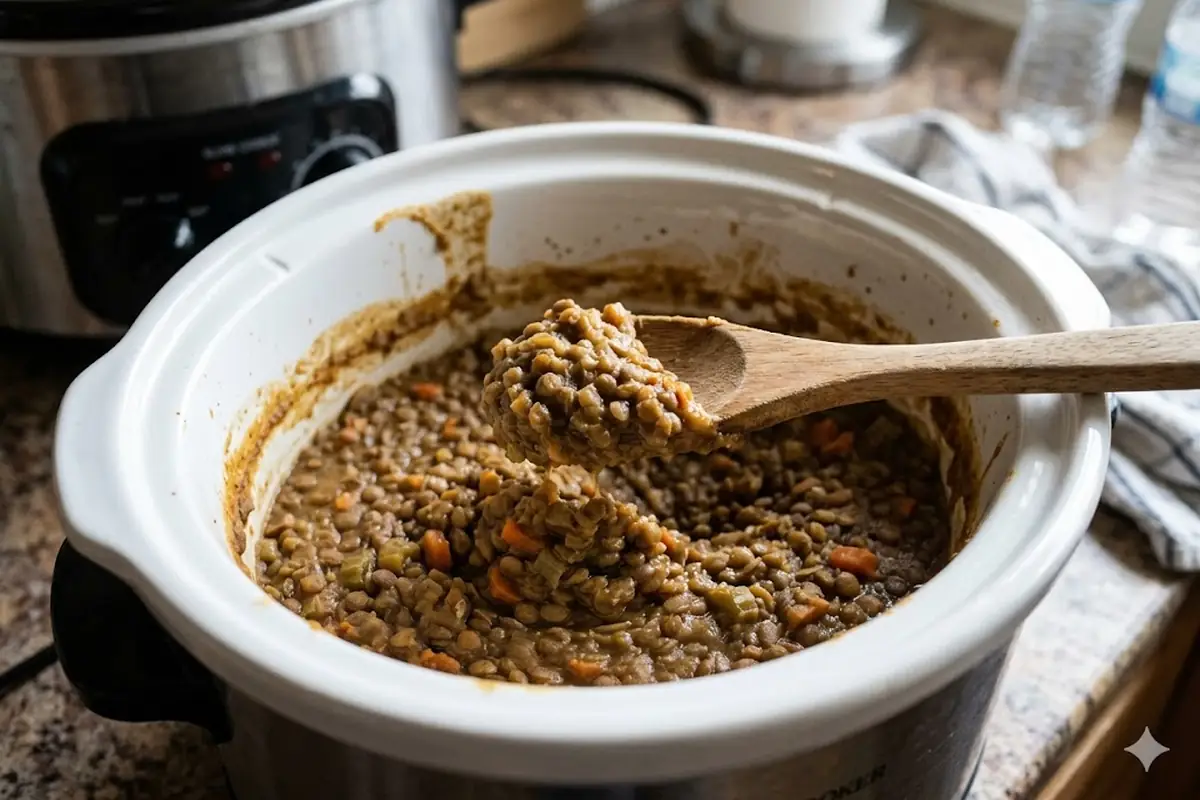
Even with good timing, a slow cooker batch can drift. These are the three failures I see most and how I walk back from each.
Lentils still hard after the full cook time. Usually the lentils are simply old. Dried lentils are not immortal, and a bag that has sat in the cupboard for two years will resist softening no matter what. If you know they are fresh and they still will not give, your tap water may be very hard, with a lot of dissolved minerals that keep the skins firm. A pinch of baking soda, about an eighth of a teaspoon for the whole pot, raises the pH and helps them surrender. Use a light hand, because too much turns them slick and soapy.
Soup turned to mush. If you overshot the time, or used red lentils expecting whole ones, you do not have to start over. Lean into it. Blend two cups of the soup and stir it back in. Suddenly the mush reads as an intentional creamy base, and the remaining whole bits give it texture. A handful of greens stirred in at the end also resets the eye, since fresh spinach or kale makes a pot look alive again.
Too thick after reheating. Lentils keep absorbing liquid in the fridge. When you warm leftovers, add a quarter cup of broth or water per bowl and stir. The soup loosens right back to where it started. This is not a flaw, it is just what legumes do.
Slow Cooker Versus the Other Methods
People ask whether the slow cooker is even the right tool for lentil soup, since lentils cook fast compared to dried beans. It is a fair question. A pot of red lentils on the stove is done in 20 minutes. So why hand the job to a machine that takes five hours? The honest answer is convenience, not speed. The slow cooker wins when you want to assemble everything in the morning and come home to dinner, or when you want a soup that holds at a low temperature for hours without scorching the bottom.
The stovetop gives you the most control and the fastest result, and it is what I reach for when I want soup in under 45 minutes. The downside is that you have to babysit it, stirring so the lentils on the bottom do not catch and burn. The Instant Pot or any pressure cooker sits in the middle, cooking brown lentils in roughly 12 to 15 minutes under pressure, then needing a natural release so they do not seize. Each method has its place. The slow cooker is the one I pick on a busy day precisely because it asks nothing of me once the lid is on.
One real tradeoff with the slow cooker is that you lose the ability to course-correct mid-cook. On the stove you can taste, adjust, and add liquid in real time. In the crock you are committed to your plan for hours. That is exactly why the timing rules above matter so much here. You cannot fix an acid mistake at hour two if you only discover it at hour six. Plan the pot, then trust it.
Make-Ahead, Freezing, and the Week-Long Payoff
This is a soup that rewards batching. It holds in the fridge for five days and only tastes better on day two as the spices settle. For the freezer, I portion it into 2-cup containers, leave a little headspace because it expands, and label the lid. It keeps for about three months without losing much. Thaw overnight, reheat on the stove, and add that quarter cup of liquid to bring it back.
If you are building a full week of plant-based meals around it, the soup pairs well with grain bowls and roasted vegetables, and I treat it as the anchor of a larger vegan meal prep plan rather than a one-off dinner. A double batch on Sunday covers lunches through Thursday with almost no extra effort, since the slow cooker does not care whether it is making four servings or eight.
For science-backed reasons to eat more legumes in general, the writeups at NutritionFacts.org are worth a read, and if you want a stovetop or one-pot version to compare technique, Forks Over Knives keeps a deep bench of plant-based soup recipes. On the comfort-food side, a pot of this alongside a bowl of pasta covers most weeknight cravings without much fuss.
Frequently Asked Questions
Do I need to soak lentils before making slow cooker lentil soup?
No. Unlike dried beans, lentils cook through without soaking, which is part of why this soup is so low-effort. Just rinse them and pick out any small stones or shriveled pieces, then add them dry to the pot. Soaking can actually make them mushier in a long slow cook.
Can I use red lentils for a soup that stays brothy?
Not really. Red lentils are bred to break down, so they will dissolve into a thick, creamy base within 4 to 5 hours on low. If you want a brothy soup with intact lentils, use brown, green, or black lentils instead. Red lentils are the right pick when you want a pureed, dal-style result.
Why are my lentils still hard after cooking all day?
The most common reason is old lentils, so check the date on the bag. The second reason is very hard water, which keeps the skins firm. A pinch of baking soda, about an eighth of a teaspoon for the whole pot, raises the pH and helps stubborn lentils finally soften.
When should I add tomatoes and lemon?
Add all acidic ingredients in the final 30 to 45 minutes. Acid firms lentil skins and stops them from softening, so a pot with tomatoes added at the start can stay gritty even after a long cook. Stir them in near the end for brightness without sabotaging the texture.
How long does slow cooker lentil soup keep?
It holds in the fridge for about five days and tastes even better on the second day as the spices meld. In the freezer it keeps roughly three months in airtight 2-cup portions. Thaw overnight and reheat on the stove, adding a splash of broth to loosen it.
Can I add greens or other vegetables?
Yes. Sturdy greens like kale can go in during the last hour, while delicate spinach should be stirred in at the very end so it wilts without turning to slime. Diced potatoes, sweet potato, or canned tomatoes all work, though add the tomatoes late for the acid reason above.
Why does my soup get so thick in the fridge?
Lentils keep absorbing liquid as the soup sits, so leftovers thicken noticeably overnight. This is normal and not a sign anything went wrong. Just stir in a quarter cup of broth or water per bowl when you reheat, and it returns to its original consistency.