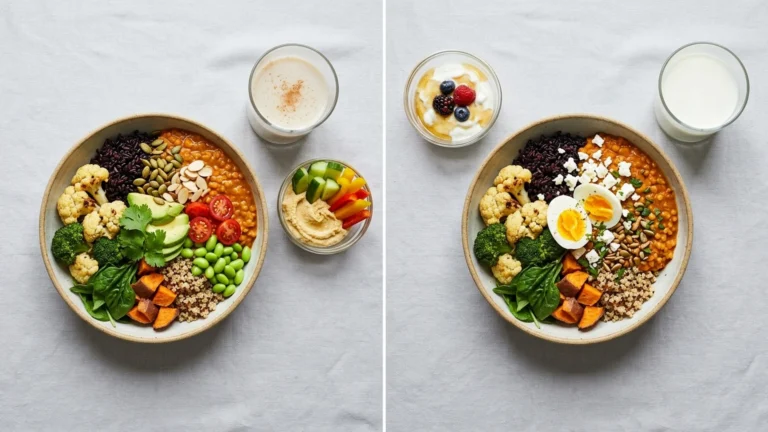
The question “is creatine vegan” comes up almost every time a plant-based lifter looks at that white tub and assumes the powder was scraped out of an animal. It was not. The creatine sold in nearly every supplement store is made in a chemical plant, not rendered from meat, and the plant-based eaters asking the question are frequently the ones who stand to gain the most from it.
Figures here are drawn from the International Society of Sports Nutrition position stand, peer-reviewed muscle and cognition research, and manufacturer process descriptions, all named in the text and listed at the end.
Quick answer: Yes. Standard creatine monohydrate is vegan because it is synthesized in a lab from sarcosine and cyanamide, with no animal input. The catch is not the creatine itself but the packaging and blends: gelatin capsule shells and some flavored formulas are not plant-based, so choose plain powder or a vegan-labeled capsule. And because dietary creatine comes almost entirely from meat and fish, vegans and vegetarians usually carry lower muscle stores, so a typical 3 to 5 grams per day of monohydrate is one of the better-supported supplements for this group.
What creatine actually is, and where your body gets it
Creatine is a small molecule your muscles and brain use to recycle energy. During short, hard efforts, cells burn ATP for fuel, and creatine phosphate hands over a phosphate group to rebuild that ATP fast. More stored creatine means a slightly deeper tank for repeated bursts of effort.
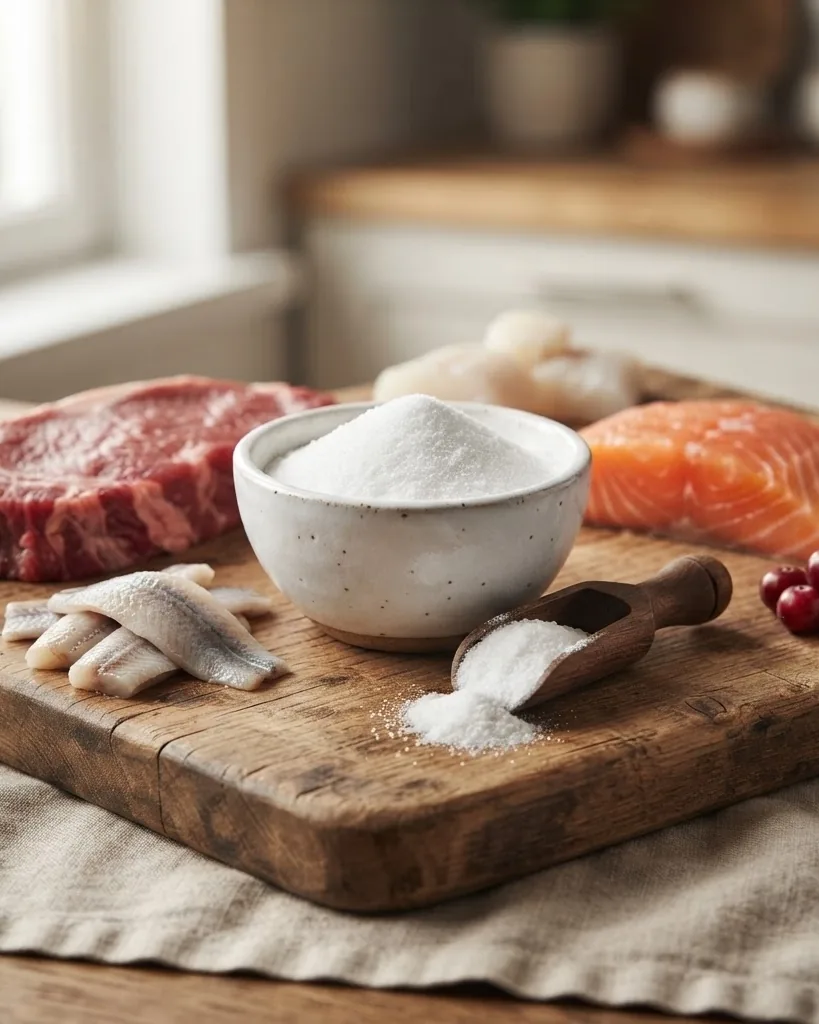
You get creatine from two places. Your liver and kidneys build roughly 1 gram a day from the amino acids arginine, glycine, and methionine. The rest normally comes from food, and here is the part that matters for this whole discussion: dietary creatine is found in meat and fish, not in plants. An omnivore eating steak, chicken, and salmon picks up another 1 to 2 grams a day without trying. A plant-based plate delivers close to zero.
The total pool your muscles are working from is about 120 grams in a typical adult, roughly 95 percent of it sitting in skeletal muscle. Each day you turn over about 1 to 2 grams of that pool into creatinine, which leaves in urine, so the tank needs constant refilling. An omnivore refills partly through the dinner plate. A vegan refills only through what the body manufactures, which is why the topic is worth a full article rather than a shrug.
So the body of a long-term vegan is running on endogenous synthesis alone. That is enough to live and train on, but it tends to leave the muscle tank partly filled compared with someone eating animal flesh daily.
Is creatine vegan? How the powder is made
Here is the manufacturing reality that settles the vegan question. Creatine monohydrate, the form in most tubs and the one with by far the deepest research base, is produced synthetically. Manufacturers react sarcosine, usually supplied as the salt sodium sarcosinate and derived from the amino acid glycine, with cyanamide, a simple carbon-nitrogen compound. The two are combined under heat and pressure, and the resulting creatine is crystallized, spun down, and dried into that familiar fine white powder.
Neither starting material is animal-derived. Both sarcosine and cyanamide are industrial chemicals produced synthetically, which is exactly why the finished creatine can be labeled suitable for vegans. Creapure, a widely used branded monohydrate made by AlzChem in Germany, states plainly that its creatine is manufactured purely synthetically and is appropriate for vegetarians and vegans. The chemistry, not a marketing slogan, is what makes it plant-based.
One honest footnote: the word “sarcosine” can appear in some animal tissues, which spooks people who skim ingredient explainers. The sarcosine feeding a creatine reactor is the synthetic version. No cow, fish, or pig is involved in standard monohydrate production.
The process itself is old and well documented. A US patent, number 5,719,319, “Process for the preparation of a creatine or creatine monohydrate,” describes reacting a sarcosine salt with cyanamide in water at controlled temperature and pH, then crystallizing out the monohydrate. The “monohydrate” part of the name just means each creatine molecule carries one water molecule locked into its crystal, which is why the powder is stable and shelf-friendly. This is chemistry-plant work, closer to how vitamin C or many amino acid supplements are produced than anything you would find at a butcher.
That distinction matters for a plant-based buyer because it flips the usual supplement worry on its head. With most animal-adjacent concerns, the burden is proving something is not sneaking in. Here the molecule is synthetic by default, and the only realistic animal contact happens later, in a gelatin capsule shell or a flavor system bolted onto the raw creatine. Keep the creatine plain and you keep the problem out entirely.
Why vegans and vegetarians often start lower
Because food creatine rides in on meat and fish, plant-based eaters predictably show up with less of it stored in muscle. Research summarized by Vegan Health and reported in the British Journal of Nutrition puts vegetarian muscle creatine near 100 to 110 mmol per kilogram of dry muscle, against roughly 120 mmol per kilogram in omnivores. That is commonly framed as 20 to 25 percent lower, though the gap varies between studies and some cohorts land closer together.
The interesting consequence is that people who start lower often respond harder when they supplement. A 2024 trial in young adult vegans and vegetarians used a 7-day load of 0.3 grams per kilogram of bodyweight, split into four daily doses. Muscle creatine climbed by 18.8 mmol per kilogram and total creatine by 30.8 mmol per kilogram, while the placebo group did not budge. The empty seats in the tank got filled.
Worth staying grounded, though: in that same short study, peak and mean power across repeated 15-second sprints did not significantly improve in one week. Filling the muscle store is not the same as an instant performance jump, and the sprint angle should not be oversold.
The broader strength picture is stronger than that one sprint result suggests, but it takes longer than seven days to read. Across the wider resistance-training literature summarized in the ISSN position stand, creatine paired with lifting produces meaningfully larger gains in strength and lean mass than lifting alone, on the order of a few extra kilograms of measurable work over weeks. For plant-based lifters specifically, the logic is simply that you have more empty capacity to fill, so the ceiling on what supplementation can add is at least as high as it is for anyone eating meat. What the evidence does not support is treating a single loading week as a performance switch. It is a slow, structural top-up that pays off through consistent training, not a pre-workout jolt.
The cognition angle, kept measured
Creatine is not only a muscle molecule. The brain also uses it, and that has driven interest in whether the people with the lowest baseline stores, again vegetarians and vegans, see mental benefits. A study in the British Journal of Nutrition on creatine and cognitive functioning reported that vegetarians tended to gain more on memory measures than omnivores, which fits the deficit idea neatly.
Caution is more useful here than breathless claims. The cognition literature is genuinely mixed. Some larger trials show small or inconsistent effects, and the strongest signals tend to appear in sleep-deprived or lower-baseline people rather than well-rested omnivores. If you are plant-based, you are plausibly in the group most likely to notice something, but “plausibly” is the honest ceiling on that claim, not a promise.
The whole body of research supports a modest, defensible position: creatine reliably fills a store that vegans start with less of, the muscle benefits for training are well established, and the brain benefits are a reasonable bonus that may or may not show up for any given person. That is a very different pitch from the “nootropic” hype you will see on some labels, and underselling it beats leaving someone feeling cheated when their memory does not suddenly sharpen in a week.
How much to take, and how
The dosing is refreshingly boring, which for a supplement is a compliment. The International Society of Sports Nutrition position stand lays out two routes.
- Load then maintain: about 0.3 grams per kilogram of bodyweight per day for 5 to 7 days, split into roughly four doses (near 20 grams a day for many adults), then drop to a maintenance dose.
- Skip the load: just take 3 to 5 grams a day from the start. You reach the same full muscle saturation, it simply takes about 3 to 4 weeks instead of one.
Most people do not need the loading theater. A flat 5 grams a day, taken whenever you will actually remember it, gets you to the same place. Consistency beats timing; the daily habit matters far more than whether you dose before or after training. Loading has one real use, which is speed: if you have a competition or a testing block four weeks out, the 5-to-7-day protocol saturates you sooner. For steady year-round training there is no rush, and the higher single doses are also more likely to cause the mild stomach upset some people report.
Mixing is its own small skill. Creatine monohydrate is not very water-soluble in cold liquid, so a spoon in ice water can leave grit at the bottom of the glass. Warmer liquid, a smoothie, or simply stirring and drinking before it settles all solve it. Undissolved powder at the bottom is wasted dose, not a defect in the product.
On safety, the ISSN reports that creatine has been used at up to 30 grams a day for as long as 5 years in healthy people, from infants to the elderly, without documented harm at recommended doses. It remains one of the most studied supplements on the shelf. That said, this is a YMYL topic: anyone with kidney disease, anyone pregnant, or anyone on medication should clear it with a clinician before starting. General safety data is not personal medical advice.

Creatine sources and forms: is it vegan?
Not every product labeled creatine is equally clean for a plant-based buyer. The molecule is vegan; the delivery format is where things slip. This table maps the common options.
| Source or form | Vegan? | Notes |
|---|---|---|
| Synthetic creatine monohydrate (powder) | Yes | Made from sarcosine plus cyanamide, no animal input. The default recommendation. |
| Creapure branded monohydrate | Yes | Made synthetically in Germany; manufacturer states suitable for vegans and vegetarians. |
| Creatine from meat or fish (diet) | No | Dietary creatine is animal-sourced; this is why vegans supplement rather than eat it. |
| Gelatin capsules | No | Shell is animal collagen. Choose powder or HPMC/cellulose “veggie” capsules. |
| HPMC / cellulose capsules | Yes | Plant-based shell. Confirm the fill is plain monohydrate. |
| Flavored or blended creatine | Depends | Colorings, flavor carriers, or additives may be animal-derived. Read the full label. |
| Creatine HCl / buffered blends | Usually yes | Also synthetic, but check binders and capsule shells; monohydrate has stronger evidence. |
How to pick a genuinely vegan creatine
Once you know the powder itself is fine, buying well is mostly about reading the parts around it. My own shopping rules have gotten shorter over the years, not longer.
- Default to plain unflavored monohydrate powder. It sidesteps capsule shells and flavor blends in one move, and it is the cheapest form of the best-studied molecule.
- If you want capsules, verify the shell. Look for HPMC, hypromellose, or “cellulose” on the label, and treat an unspecified “capsule” as gelatin until proven otherwise.
- Scan flavored tubs for the weak points: added color, “natural flavor” carriers, or fortification that is not clearly plant-based.
- Trust third-party marks. The Vegan Society Trademark confirms the vegan claim, while Informed Sport, Informed Choice, or NSF Certified for Sport confirm the tub was screened for banned contaminants. Creapure branding is a useful shortcut for the creatine itself.
It is worth understanding what those marks actually promise, because they are not interchangeable. A vegan label speaks only to ingredients and animal input. An Informed Sport or NSF Certified for Sport mark speaks to contamination testing, meaning batches are screened for substances banned in competition, which matters most to drug-screened athletes but also signals a manufacturer willing to pay for outside scrutiny. Neither certification is a purity or potency guarantee on its own, so read them as a package: a vegan claim that can be verified, plus a testing mark that shows the company is not cutting corners elsewhere. When a product carries both, along with a short ingredient list, there is little left to deliberate.
One more label habit worth building: check the serving math. A tub advertising “100 servings” at 5 grams needs about 500 grams of creatine in it, so confirm the net weight lines up. If it does not, the scoop is under a full dose and you are quietly underdosing.
None of this requires a premium price. A basic tub of third-party-screened, unflavored monohydrate is one of the lowest cost-per-serving supplements you can buy, often landing well under 30 cents a daily serving, which is another reason it earns its spot for plant-based eaters over flashier formulas. Be skeptical of “advanced” creatine blends charging several times more for HCl, buffered, or micronized versions with thinner evidence behind them. Micronized simply means the same monohydrate ground finer so it mixes easier, which is a convenience, not an upgrade in what the molecule does inside muscle.
Where creatine fits in a plant-based routine
Creatine is not a protein, and it does not replace one. If your baseline plant-based eating still needs work, sort that first; our guide to vegan protein and the running list of high protein vegan foods cover the foundation that creatine sits on top of, not instead of. For the bigger picture on whether plant-based eating stacks up nutritionally, our honest look at whether vegans are healthier is a fairer starting point than any single supplement.
Think of creatine as a targeted top-up for a nutrient your diet structurally lacks, similar in spirit to how many plant-based eaters supplement B12. You are not fixing a broken diet; you are filling a specific gap that comes with skipping meat and fish.
Five grams into the morning smoothie, done, no ritual and no expectation of fireworks. What to expect is not a sudden strength spike but a quiet steadiness on the last hard set, the reps that used to fall apart holding together a little more often. That is a modest, honest return, and it fits what the research actually promises rather than what the flashiest labels imply. If you are plant-based and lifting with any seriousness, plain third-party-screened monohydrate is close to the easiest evidence-backed decision on the whole supplement shelf.
Frequently asked questions
Is creatine vegan if it comes in capsules?
The creatine inside is still vegan, but the capsule shell may not be. Gelatin shells are animal-derived, so choose HPMC or cellulose u0022veggieu0022 capsules, or just use plain powder.
Do vegans actually need creatine supplements?
Need is strong; benefit is fair. Plant-based eaters carry lower muscle creatine because they get almost none from food, so supplementing tends to help more than it does for omnivores. It is optional, not mandatory.
How much creatine should a vegan take per day?
A flat 3 to 5 grams of monohydrate daily is the standard maintenance dose per the ISSN position stand. You can load with about 20 grams a day for a week first, but it is not required.
Is synthetic creatine as good as creatine from meat?
Yes, and arguably more relevant for vegans. Synthetic monohydrate is the exact same molecule studied in most research, and it raises muscle stores effectively, which dietary meat creatine simply cannot do for a plant-based eater.
Will creatine make me hold water or look bloated?
Creatine draws a little water into muscle cells, which can add a small amount of scale weight early on. It is intracellular, not the puffy subcutaneous bloat people fear, and it settles.
Is creatine safe to take long term?
For healthy adults, the evidence is reassuring, with use up to 30 grams a day for as long as 5 years reported as well tolerated. Anyone with kidney disease or other medical conditions should check with a clinician first.nnSources: International Society of Sports Nutrition position stand (Kreider et al., Journal of the International Society of Sports Nutrition, via NIH PMC); British Journal of Nutrition (creatine and cognitive functioning; muscle creatine baselines); a 2024 muscle creatine and sprint trial in vegans and vegetarians (NIH PMC); Vegan Health; and Creapure manufacturer process information.nnFor the primary references, see the ISSN position stand on creatine and the Vegan Health overview of creatine.