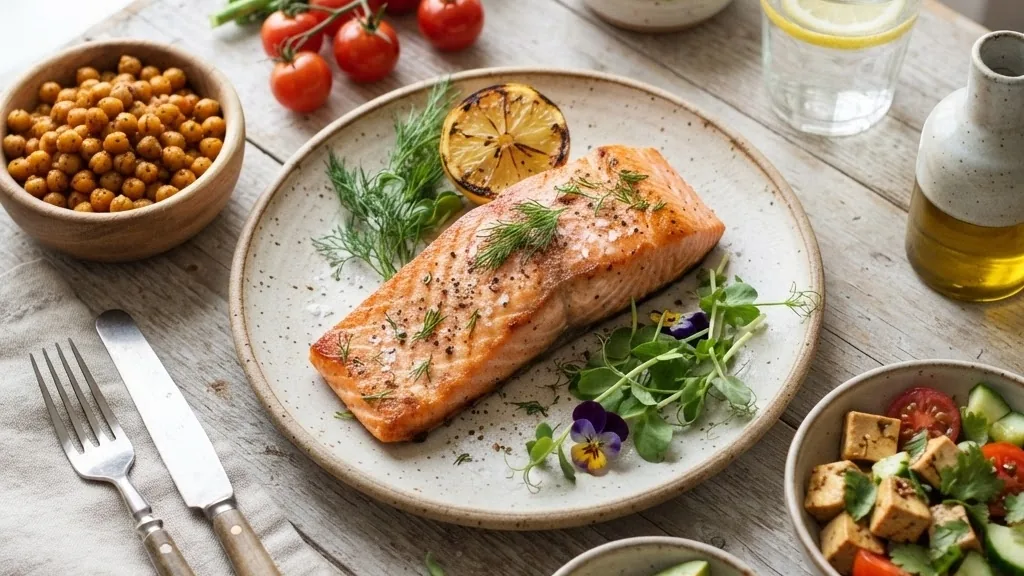
The question “can i eat fish on a vegan diet” comes up constantly, and the honest answer is no. Fish is an animal, so eating it is not vegan by any standard definition. Someone who eats a plant-based plate plus salmon or tuna is a pescatarian, not a vegan. This guide walks through why that line is where it is, because the reasons behind it are more interesting than a flat no, and because the nutrition worries that push people toward fish have plant answers.
Sourced from The Vegan Society’s published definition and the NIH Office of Dietary Supplements, with numbers checked against those bodies.
Quick answer: No, you cannot eat fish and still call the meal vegan. The Vegan Society, the UK charity that coined the word in 1944, defines a vegan diet as one that excludes all animal products, and it names fish and shellfish specifically. Fish are animals, so fish is off the table. If you eat mostly plants but keep fish, the accurate word is pescatarian. The main reason people ask is omega-3, and the fix is straightforward: algae oil delivers the same EPA and DHA that fish carry, because fish only get those fats from eating algae in the first place.
The short answer, and why it is not a close call
Veganism is defined by one line: no animal products. Fish are animals. That is the entire logic, and it does not bend for canned tuna, anchovies hidden in a sauce, or the fish sauce in a curry paste. The question often carries a hope that fish is a gray area, the way honey or refined sugar sometimes get debated. It is not. Fish sits in the same category as chicken and beef.
They had eaten mostly plants for a year and thought fish was the one flexible rule. It was not a moral failing; it was a labeling problem, and that is worth untangling.
What “vegan” actually means
The word has an owner, more or less. The Vegan Society was founded in 1944 by Donald Watson and a small group who wanted a term for people who avoided all animal foods, not just meat. Their definition, still the reference point today, reads: veganism is a philosophy and way of living which seeks to exclude, as far as is possible and practicable, all forms of exploitation of, and cruelty to, animals for food, clothing or any other purpose. In dietary terms, they add, it means dispensing with all products derived wholly or partly from animals.
Crucially, the same body spells out what that covers on the plate: meat, and they list fish, shellfish and insects in that meat category, plus dairy, eggs and honey. So this is not a matter of interpretation. The organization that created the word put fish on the excluded list in writing. If you want the primary source, read the definition of veganism directly. For a plainer walkthrough of the whole idea, see what is vegan.
Vegan vs pescatarian vs plant-based
Most of the confusion clears up the moment you line the diets up side by side. These are not rankings; they are labels that mean specific things, and using the right one saves everyone a headache at the dinner table.
| Diet type | Eats fish or seafood? | Eats dairy or eggs? | Plants only? |
|---|---|---|---|
| Vegan | No | No | Yes, fully plant based |
| Pescatarian | Yes | Usually yes | No |
| Vegetarian (lacto-ovo) | No | Yes | No |
| Plant-based (informal) | Sometimes | Sometimes | Not guaranteed |
A pescatarian eats an otherwise vegetarian diet and adds fish and seafood; most pescatarians also keep dairy and eggs, and they typically drop red meat and poultry. A lacto-ovo vegetarian skips all meat and fish but keeps eggs and dairy. A vegan drops the lot. And “plant-based,” the row that causes the most trouble, is not a governed term at all, which is exactly why two people can use it and mean two different things. If the vegetarian and vegan line is still fuzzy for you, the two are compared properly in vegan vs vegetarian.
Why the confusion happens in the first place
The usual culprit is the phrase “plant-based,” which people use to mean very different things: strict vegan, vegan at home but fish when eating out, or simply cutting back on beef. None of them were wrong by their own logic, because the phrase has no official meaning. Fish gets a pass in a lot of people’s heads because it feels lighter, healthier, and less like the meat they were trying to cut.
There is also a health-halo effect. Fish carries a reputation as the good animal protein, so people reach for it while trimming everything else and assume it slides under the vegan bar. It does not. A useful test: if it swam, had a face, or came from something that did, it is not vegan. That settles fish, shrimp, oysters, and the fish sauce lurking in a takeout pad thai.
- “Plant-based” has no legal or standardized definition, so it gets stretched.
- Fish reads as a health food, which makes it feel exempt.
- Hidden fish shows up in fish sauce, oyster sauce, Worcestershire, and some kimchi and Caesar dressings.
- Flexitarian and pescatarian eating gets loosely called “mostly vegan,” which muddies the word.
The flexitarian label adds another layer of blur. A flexitarian eats mostly plants but eats meat or fish sometimes, with no fixed rule about how often. It is a spectrum, not a line, which is the opposite of vegan, where the rule is absolute. Someone who is “basically vegan but eats fish” is describing a flexitarian or pescatarian pattern. Nothing wrong with either. The only error is the word, and the word matters, because a host or a restaurant relies on “vegan” to mean no animal products, full stop. When it quietly means fish is fine, the vegan diner who genuinely cannot have fish gets caught out.
On labels, the fish problem is sneakier than the dairy problem. Milk and eggs get printed as allergens in bold, but fish-derived ingredients often hide behind names like anchovy extract, fish stock, or vague “natural flavors.” Shrimp paste, for example, can sit three lines into the ingredients of a green curry paste. If a package leans on umami and does not say vegan on the front, flip it over and read every line, because the fish is usually in the flavor base, not the headline ingredient.
The omega-3 question, which is the real reason people ask
Strip away the labels and most people asking about fish are actually asking about one nutrient: omega-3. This is the honest core of the question, so it deserves real numbers rather than reassurance. There are three omega-3 fatty acids that matter. ALA is the short-chain form found in plants. EPA and DHA are the long-chain forms found in fish and marine life, and they are the ones tied to heart and brain research.
Here is the fact that reframes the whole thing: fish do not manufacture EPA and DHA. They accumulate it by eating microalgae. Algae is the original source, and the fish are just the middle step. That means you can skip the fish and go to the source. Algae oil supplements supply EPA and DHA directly, no conversion required, usually delivering somewhere around 300 to 1000 mg of combined EPA and DHA per serving, which is comparable to a fish oil capsule. Research published in the Journal of Nutritional Science found algae oil raised blood levels of EPA and DHA about as effectively as fish oil.
The plant side also gives you ALA to build on. According to the Institute of Medicine, the Adequate Intake for ALA is 1.6 g per day for men and 1.1 g per day for women aged 19 to 50. Hitting that from food is easy.
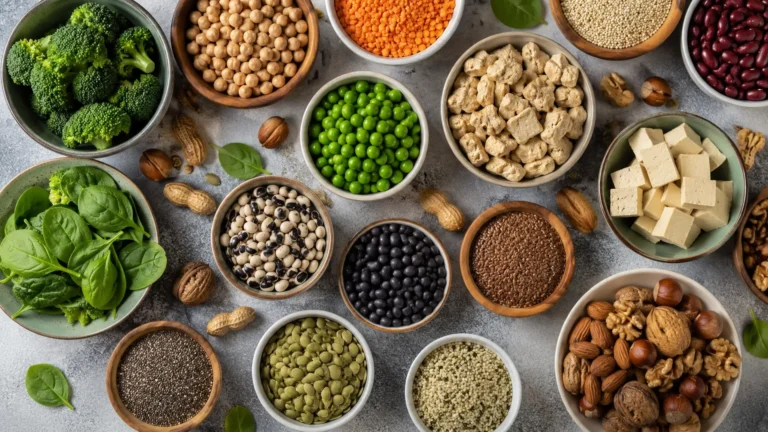
- Ground flaxseed: about 1.6 g of ALA per tablespoon, which alone meets a man’s daily target.
- Chia seeds: roughly 2 to 2.5 g of ALA per tablespoon.
- Walnuts: about 2.5 g of ALA per ounce, which is around 14 halves.
One caveat matters here: the body converts ALA to EPA at only about 5 to 10 percent, and to DHA at under 1 percent. So flax and chia cover your ALA generously, but they are a weak way to reach EPA and DHA.
The reason the conversion runs so low is worth understanding. The same enzyme pathway that turns ALA into EPA and DHA also processes omega-6 fats, and a typical Western diet is heavy on omega-6 from seed and vegetable oils, so the two fats compete for the same machinery. Conversion also leans on adequate zinc, iron, vitamin B6, and enough total calories. The DHA step is the bottleneck, which is why you cannot chia-seed your way to a solid DHA level.
That is why algae oil is the better route to the long-chain fats; a walnut habit does not do the same job. On dosing, most vegan omega-3 guidance lands around 200 to 300 mg of combined EPA and DHA per day from algae oil for maintenance, which a single small softgel covers, and taking it with a meal that has some fat helps it absorb better.
A tablespoon of ground flax stirred into oatmeal is an easy daily habit; grind it rather than using it whole, since whole flax tends to pass straight through and do nothing. Seaweed and marine algae also show up in food form, which is part of why a dish like a seaweed salad earns a spot in a plant-based rotation.
If you want the government reference on all three omega-3s and their intake levels, the NIH Office of Dietary Supplements omega-3 fact sheet lays it out without the supplement-brand spin.
B12 and iodine, the two nutrients to plan for
The second nutrient that pushes people toward fish is vitamin B12, and this one deserves a straight answer because it is the one nutrient a vegan genuinely cannot wing. According to the NIH Office of Dietary Supplements, the recommended intake of B12 for adults is 2.4 mcg per day, and plant foods contain no B12 unless they are fortified. Fish carries B12, which is part of why it gets recommended, but you do not need the fish to get it.
Vegans cover B12 with fortified foods, some breakfast cereals and nutritional yeast among them, or with a supplement. Doses vary widely: multivitamins commonly carry 5 to 25 mcg, while standalone B12 supplements often run 500 to 1000 mcg, since the body only absorbs a fraction of a large dose at once. The practical takeaway is that B12 is a solved problem for vegans, not a reason to add fish. It just takes one deliberate choice, whether a fortified food eaten regularly or a weekly tablet.
Iodine is the nutrient people forget when they drop fish, and too few articles flag it. Seafood is one of the richest natural iodine sources, so cutting fish quietly removes a major supply. The NIH Office of Dietary Supplements sets the adult RDA at 150 mcg per day, and it names vegans among the groups who may fall short. The clean fix is iodized salt: a quarter teaspoon covers a large share of the daily need.
Here is the catch, though. Specialty salts, sea salt, kosher salt, Himalayan pink, and fleur de sel, are usually not iodized, and neither is the salt baked into processed foods. So a cook who has switched to fancy flaky salt may be getting almost no iodine. Seaweed does carry iodine, but the amount swings wildly by type, and kelp can deliver up to a hundred times the RDA in one serving, which is too much, so kelp is best treated as a garnish and not a daily supplement.
The ethics and environment behind the rule
The reason fish is excluded is not arbitrary line-drawing. Go back to the definition: it is about excluding exploitation of and cruelty to animals. Fish are animals, so from the vegan starting point the ethical case for not eating a fish is the same as for not eating a cow. Whether or not you personally share that view, it explains why the definition treats fish exactly like every other animal rather than carving out an exception.
Beyond ethics, the reasons vegans commonly cite against fish are environmental. Overfishing has drawn down many wild stocks, with global assessments repeatedly flagging that a large share of monitored fisheries are fished at or beyond their sustainable limit. Bycatch, the non-target animals caught and discarded by some fishing methods, sweeps up dolphins, turtles, and seabirds, and in some fisheries the discarded catch rivals the intended one.
Bottom trawling, where heavy gear is dragged across the seafloor, can flatten habitat that took decades to form. Even farmed fish is not a clean out, since many farmed species are fed wild-caught smaller fish, so aquaculture pulls on the same ocean it was meant to spare. Single statistics are easy to overstate here, because the numbers vary by fishery, method, and year, but these concerns are the standard environmental argument, and they are why plenty of people who came for the health angle end up staying for the ecology one.
You do not have to adopt the whole philosophy to answer the original question. You can respect fish as a food, eat it happily, and simply understand that doing so makes you a pescatarian. The label is descriptive, not a judgment. What it is not is vegan.
How to cook around it without missing fish
Replacing the fish experience in the kitchen is easier than replacing the nutrients. The briny, oceanic flavor people miss comes mostly from seaweed, capers, miso, and a squeeze of lemon, not from the fish itself. Nori, dulse flakes, and kelp granules give a dish that sea note, and marinated pressed tofu or hearts of palm can stand in for the flaky texture in tacos and cakes.
One kitchen caution worth passing on: walnuts toasted too hot, chasing that omega-3 crunch, can scorch a whole tray at 350F in about 9 minutes. Low and slow is the rule, because the oils that carry the omega-3 are fragile and turn bitter under high heat. Toast nuts and seeds gently, keep ground flax cold and fresh, and lean on algae oil for the fats you cannot get any other way.
Frequently asked questions
Is fish considered meat for a vegan?
Yes. The Vegan Society lists fish and shellfish inside the meat category that vegans exclude. Fish is an animal product, so for vegan purposes it is treated exactly like beef or chicken.
If I only eat fish once a week, am I still vegan?
No. Eating fish at any frequency means the diet is not vegan. Occasional fish with an otherwise plant-based diet makes you a flexitarian or pescatarian, depending on the rest of your eating.
What is the difference between a pescatarian and a vegan?
A pescatarian eats fish and seafood and usually dairy and eggs, while avoiding red meat and poultry. A vegan eats no animal products at all, including fish, dairy, eggs, and honey.
How do vegans get omega-3 without fish?
Vegans get ALA from flaxseed, chia, and walnuts, and get the long-chain EPA and DHA from algae oil, which supplies the same fats fish do because fish get them from algae in the first place.
Do I need fish for vitamin B12 on a vegan diet?
No. Plant foods do not contain B12 unless fortified, so vegans use fortified foods or a supplement to reach the 2.4 mcg adult daily target. Fish is one source of B12, but it is not a required one.
Why is fish not allowed on a vegan diet at all?
Because veganism is defined by excluding all animal products and all exploitation of animals, and fish are animals. The definition makes no exception for seafood, so fish is excluded on the same basis as any other animal food.
Sources: The Vegan Society (definition of veganism, founded 1944); NIH Office of Dietary Supplements (omega-3 fatty acids and vitamin B12 fact sheets); Institute of Medicine / National Academies (Adequate Intake for ALA); Journal of Nutritional Science (algae oil versus fish oil).