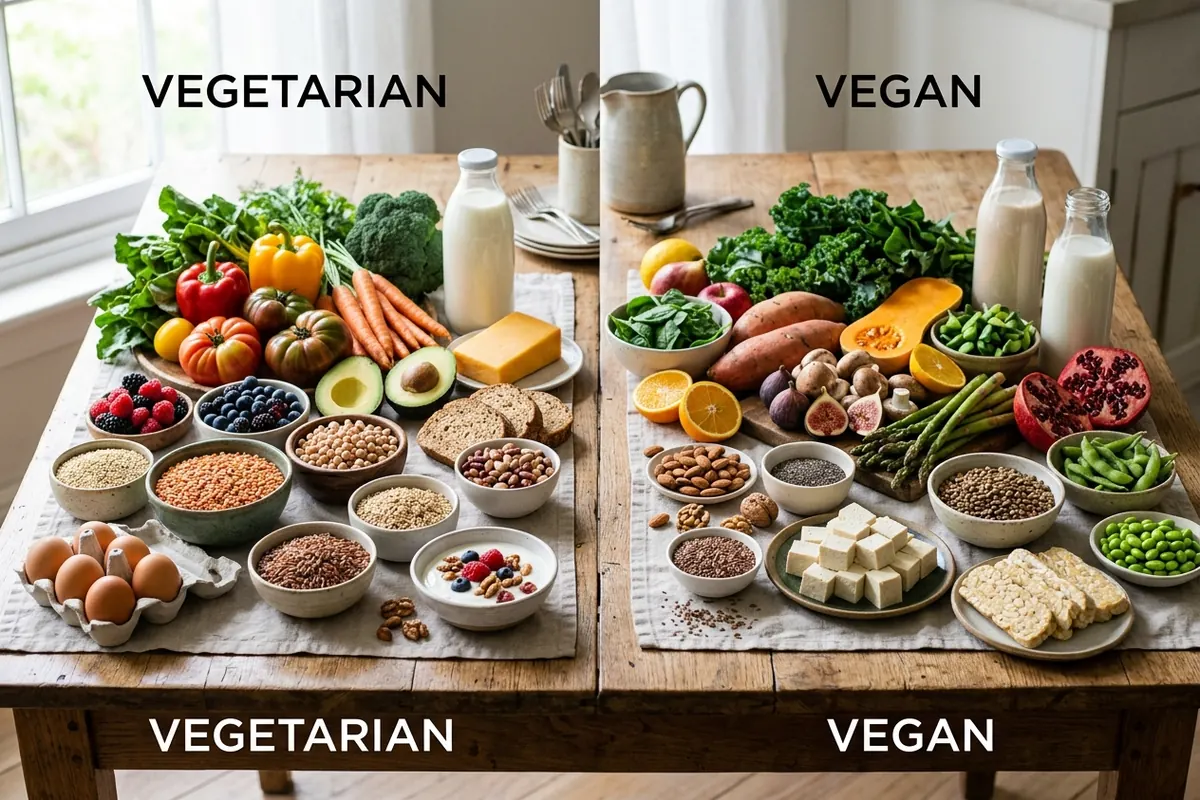
The vegan vs vegetarian question comes up constantly, and the difference is simpler than most people think: a vegetarian avoids meat, poultry, and fish, while a vegan avoids all animal products entirely, including dairy, eggs, and honey. Every vegan is technically a vegetarian, but not every vegetarian is a vegan. That single distinction, whether or not you include the things animals produce rather than the animals themselves, is the whole heart of it. A vegetarian might enjoy an omelet, a cheese pizza, or yogurt; a vegan would pass on all three.
Beyond that core difference, though, lies a surprising amount of nuance worth understanding, especially if you are weighing which path fits your own life. There are several types of vegetarian, real nutritional considerations that set the two apart, an environmental and ethical dimension, and the eternal question of which one is actually healthier. The answer is rarely as black and white as the internet makes it sound. This guide walks through exactly what each term means, the variations within them, where the nutrition diverges, and how to figure out which approach suits you, without any preaching. Let us sort it out clearly.
What vegetarian actually means
Vegetarian is the broader, older, and more flexible of the two terms, and it is really an umbrella covering several styles of eating. What unites them all is the absence of meat, poultry, and fish. What separates them is which animal byproducts they allow. Understanding these subtypes clears up most of the confusion, because when someone says they are vegetarian, they could mean any of a few things.
A lacto-ovo vegetarian, the most common type in much of the world, eats both dairy and eggs but no meat or fish. A lacto vegetarian includes dairy but skips eggs, a pattern common in parts of India for cultural and religious reasons. An ovo vegetarian does the reverse, eating eggs but no dairy. And then there is the pescatarian, who avoids meat and poultry but still eats fish and seafood, which many purists argue is not truly vegetarian at all, though it is a popular and practical middle ground. The flexitarian, meanwhile, is mostly plant-based but eats meat occasionally, a label for people moving in the vegetarian direction without committing fully. The common thread is that vegetarianism leaves room for animal products that do not require slaughtering the animal.
What vegan actually means
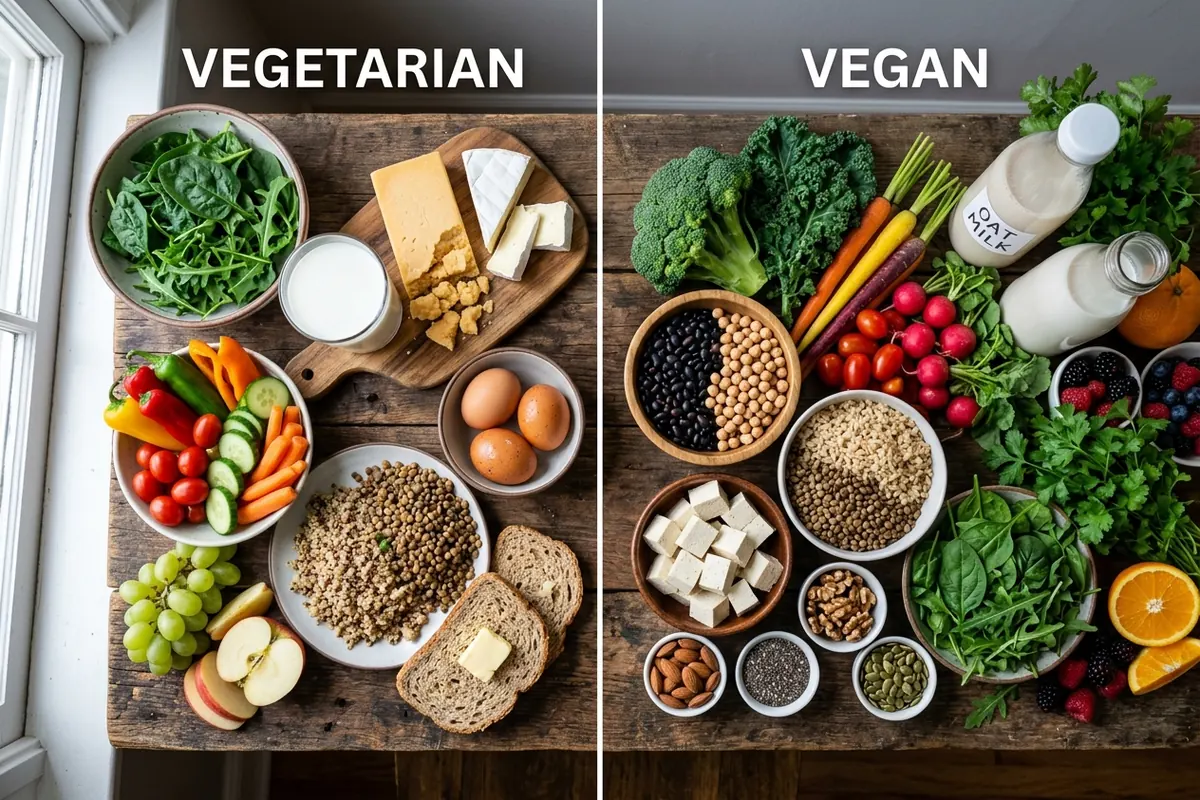
Veganism is the stricter and more comprehensive path, and for many people it is as much a lifestyle and ethical stance as a diet. A vegan excludes every food that comes from an animal in any form: no meat, fish, or poultry, and crucially no dairy, eggs, honey, gelatin, or other animal-derived ingredients. If an animal made it or it came from an animal’s body, a vegan leaves it off the plate.
For a great many vegans, the philosophy extends well past food into daily life. They often avoid leather, wool, silk, and down, skip cosmetics and household products that involve animal testing, and steer clear of anything involving animal exploitation, from honey to certain wines filtered with animal products. This is the key reason veganism feels like a bigger commitment than vegetarianism: it is a consistent principle applied across everything, not just the dinner table. That said, plenty of people adopt a plant-based diet for health reasons alone without the broader lifestyle, and the food itself is identical. The motivation differs, but the plate looks the same.
The nutritional differences that actually matter
From a nutrition standpoint, vegetarian and vegan diets are far more alike than different, since both are built on the same foundation of vegetables, fruits, legumes, grains, nuts, and seeds. But the exclusion of dairy and eggs does create a few specific gaps that vegans need to plan around more deliberately than vegetarians do, and being honest about these is the responsible thing to do.
The big one is vitamin B12, which occurs naturally almost only in animal products. Vegetarians can get some from dairy and eggs, but vegans must rely on fortified foods or a supplement, full stop, because a B12 deficiency is serious and creeps up slowly. Calcium is another, since vegetarians often get plenty from dairy while vegans need to lean on fortified plant milks, tofu set with calcium, leafy greens, and tahini. Vegans also have to be a touch more intentional about complete protein, iron, omega-3 fatty acids, and vitamin D, all of which are absolutely achievable from plants with a little knowledge but do not happen entirely by accident. None of this makes a vegan diet deficient, it simply means a vegan benefits from understanding where these nutrients come from, a point the evidence-based resources at NutritionFacts.org cover thoroughly. A well-planned diet of either kind is nutritionally complete.
One practical point that often gets lost: the fortified foods that fill these gaps are everywhere now and easy to work in. Most plant milks, many breakfast cereals, nutritional yeast, and some meat substitutes come fortified with B12, calcium, and vitamin D, which means a modern vegan diet is far easier to balance than it was a decade ago. A single daily multivitamin or B12 tablet closes the most important gap entirely, and a yearly blood test to check your levels is a smart, low-effort habit for anyone on either diet. None of this is complicated once you know to look for it.
So which one is actually healthier?
Here is the honest answer that nuance demands: neither is automatically healthier than the other, and the gap between them is much smaller than the gap between either one and a typical meat-heavy Western diet. Large studies consistently show that both vegetarians and vegans tend to have lower rates of heart disease, high blood pressure, type 2 diabetes, and certain cancers compared with heavy meat-eaters. That is the headline benefit, and it applies to both camps.
Between the two, the differences are subtle. Some research suggests vegans may have a slight edge in markers like cholesterol and body weight, partly because cutting dairy and eggs removes some saturated fat, but the effect is modest and not guaranteed. The far bigger factor is the quality of the diet within either label. A vegan living on french fries, soda, and processed mock meats is not healthier than a vegetarian eating whole grains, beans, vegetables, and a little yogurt. Whole foods beat processed ones every time, regardless of the label on the box. So the healthiest version of either diet is the one built on real, minimally processed plant foods, and that is the lens worth using rather than vegan-versus-vegetarian point-scoring.
The ethical and environmental angle
For many people the choice between these two is driven less by nutrition than by values, and this is where veganism’s all-or-nothing consistency really shows. The dairy and egg industries involve animals even though no meat is eaten, so vegans who object to animal use on principle find vegetarianism an incomplete solution. Vegetarians, by contrast, often draw the line at slaughter, finding a comfortable and sustainable middle they can maintain for life.
Environmentally, both diets shrink your footprint considerably compared with eating meat, since animal agriculture is a major driver of greenhouse gas emissions, land use, and water consumption. A vegan diet generally has the smallest footprint of all, but a vegetarian diet is still a large improvement over a meat-centric one, and dairy in particular carries a meaningful environmental cost that vegans avoid. There is no need to frame this as a contest. Both directions move the needle, and the most sustainable choice is ultimately the one you can stick with happily over the long haul rather than the strictest one you abandon in a month.
It is worth noting that the two communities tend to be allies rather than rivals on these questions. Most vegans were vegetarians first, and most vegetarians are sympathetic to the vegan position even if they have not adopted it. The infighting you sometimes see online does not reflect how supportive these circles usually are in real life, where the shared goal of eating fewer animal products unites far more than the precise dividing line separates. If you are just starting out, you will find both communities welcoming and full of practical advice rather than judgment, and leaning on that collective knowledge makes the transition far smoother than going it alone.
Common myths about both diets
A few persistent myths cloud this whole conversation, and clearing them up makes the choice a lot less intimidating. The most stubborn is the idea that you cannot get enough protein without meat. In reality, beans, lentils, tofu, tempeh, edamame, seitan, nuts, seeds, and whole grains supply ample protein, and most people eating a varied plant-based diet hit their protein needs without trying. Athletes and bodybuilders thrive on both diets. Protein is simply not the obstacle it is made out to be.
Another myth is that these diets are inherently expensive. While specialty mock meats and vegan cheeses can cost a premium, the backbone of plant-based eating, dried beans, rice, oats, seasonal vegetables, and frozen produce, is among the cheapest food in any grocery store. Built around whole ingredients, both diets can cost less than a meat-centered one, not more. A related myth holds that the food is bland or limited, which anyone who has explored Indian, Ethiopian, Thai, Mexican, or Mediterranean cooking knows is nonsense, since entire cuisines are largely plant-based and bursting with flavor.
Finally, there is the myth that you must be perfect or it does not count. Plenty of people eat vegetarian most of the time, or vegan at home and flexible when traveling, and still capture the bulk of the health and environmental benefits. Treating it as all-or-nothing causes more dropouts than any nutritional hurdle. Progress beats purity, and a diet you can live with for years does far more good than a strict one you quit in a month.
What a day of eating looks like on each
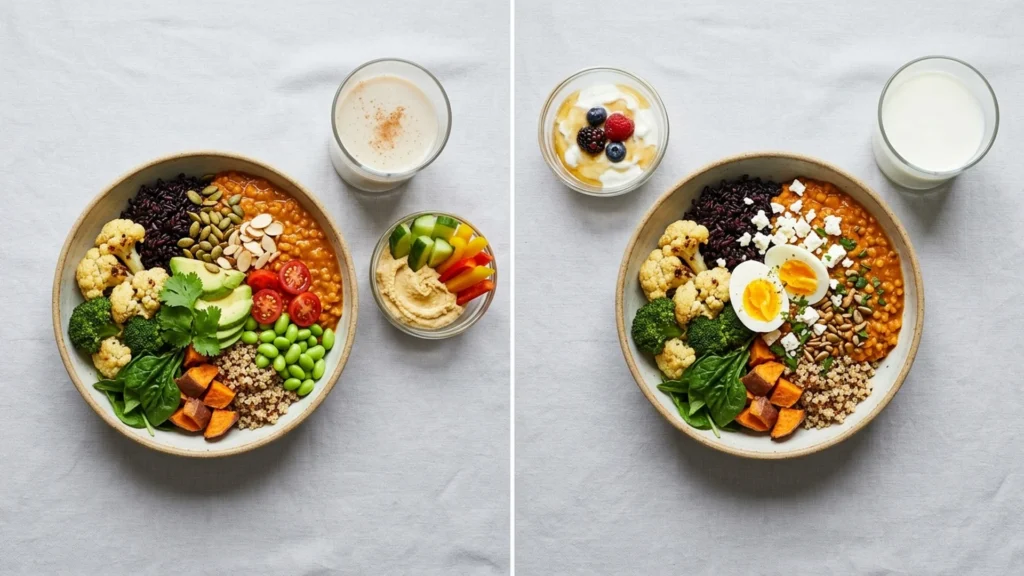
To make this concrete, picture a typical day on each diet, because the overlap is striking. A vegetarian might start with yogurt and granola or scrambled eggs on toast, have a lentil soup with a cheese sandwich for lunch, snack on hummus and crackers, and finish with a vegetable stir-fry over rice with a fried egg on top. Dairy and eggs show up at the edges, but the center of the plate is plants.
A vegan’s day looks almost identical with those edges swapped out: oatmeal with almond milk and berries or a tofu scramble for breakfast, the same lentil soup with an avocado sandwich for lunch, the same hummus and crackers, and that same vegetable stir-fry over rice, this time crowned with crispy tofu instead of an egg. Once you see the two side by side, you realize how small the daily difference really is, and how easily a vegetarian can drift toward vegan one swap at a time. That gentle, swap-by-swap path is exactly how most long-term plant-based eaters got where they are, and it is far more durable than a dramatic overnight overhaul.
How to choose the right path for you
So how do you decide? Start with your motivation, because it points the way. If your driver is purely health, a well-planned vegetarian diet captures most of the benefits with a gentler learning curve, and you can always tighten toward vegan over time. If your driver is animal ethics applied consistently, veganism is the logical fit, since it closes the loopholes vegetarianism leaves open. If the environment is your concern, both help, with vegan helping most.
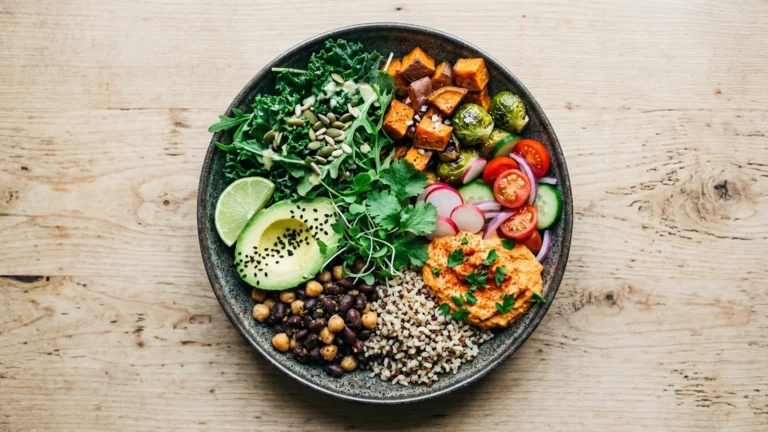
Starting where you can sustain it usually works better than starting where you think you should be. Many lifelong vegans began as vegetarians and shifted gradually as their cooking confidence grew, and that ramp is a perfectly valid path. Try building a few naturally plant-based meals into your week and see how it feels. A bowl of fresh guacamole with vegetables, a fresh grilled corn salad, or a tray of caramelized grilled Brussels sprouts are crowd-pleasers that happen to be fully vegan, and a hearty pot of vegetable soup proves how satisfying plant-based comfort food can be. Let your plate evolve at its own pace. For a wealth of recipes that work for both vegetarians and vegans, the kitchen at Forks Over Knives is a dependable companion.
Frequently asked questions
What is the main difference between vegan and vegetarian?
The main difference is animal byproducts. Vegetarians avoid meat, poultry, and fish but may eat dairy, eggs, and honey. Vegans avoid all animal products entirely, including dairy, eggs, and honey, and often extend that to non-food items like leather and wool. Every vegan is a vegetarian, but not the reverse.
Can vegetarians eat eggs and cheese?
Most can. The common lacto-ovo vegetarian eats both eggs and dairy like cheese, while avoiding meat and fish. Some vegetarians choose to skip one or the other, becoming lacto or ovo vegetarians. Vegans, by contrast, eat neither eggs nor cheese, since both come from animals.
Is vegan or vegetarian healthier?
Neither is automatically healthier, and the difference between them is small. Both are linked to lower rates of heart disease and other conditions compared with heavy meat diets. What matters most is eating whole, minimally processed plant foods rather than relying on processed substitutes, which applies equally to both diets.
Do vegans need supplements?
Vegans should take vitamin B12, which is found naturally almost only in animal products, and may benefit from vitamin D and omega-3 supplements depending on their diet and sun exposure. Iron, calcium, and protein can usually be met through food with a little planning. Vegetarians who eat dairy and eggs have fewer gaps.
Is a pescatarian a vegetarian?
Technically no, though the term is often grouped nearby. A pescatarian avoids meat and poultry but still eats fish and seafood, which means they consume animal flesh. Many people use it as a stepping stone toward vegetarianism or for the health benefits of fish while cutting other meats.
Which diet is better for the environment?
Both reduce your environmental footprint significantly compared with eating meat. A vegan diet generally has the smallest footprint because it also eliminates dairy and eggs, which carry their own environmental costs. A vegetarian diet is still a major improvement over a meat-centered one, so both are meaningful steps.
The bottom line
The vegan vs vegetarian distinction comes down to one clear line: vegetarians skip the meat but may keep dairy and eggs, while vegans skip all animal products and often the lifestyle items too. Nutritionally they are close cousins, both far healthier than a meat-heavy diet, with vegans needing slightly more planning around B12 and calcium. Choose based on your motivation, whether health, ethics, or the planet, and start at a pace you can actually sustain. The best diet is not the strictest one on paper, it is the nourishing, plant-forward one you will still be happily eating a year from now.