Is almond milk gluten free? In its plain form, yes, but that is not the whole story, and the gap between “usually fine” and “safe for celiac disease” is where people get caught out. Plain almond milk is just almonds and water, neither of which contains gluten. The risk does not come from the milk itself. It comes from what brands add to it and where they make it.
Plant milk cartons are worth reading the way someone with a wheat allergy reads a bakery menu. This guide walks through why the base is safe, the few ingredients that can sneak gluten in, how to read an almond milk label with confidence, and the difference between a casual gluten-free choice and a truly celiac-safe one.
The short answer
- Plain almond milk is gluten free. It is made from almonds and water, and neither contains gluten.
- Flavored and specialty versions are the risk. Vanilla, chocolate, and some “barista” blends can carry gluten through malt or additives.
- For celiac disease, look for a certified gluten-free label. That is the difference between probably fine and verified safe.
If you remember one thing, remember this: the almond milk is rarely the problem. The flavorings and the factory are.
Why plain almond milk is gluten free
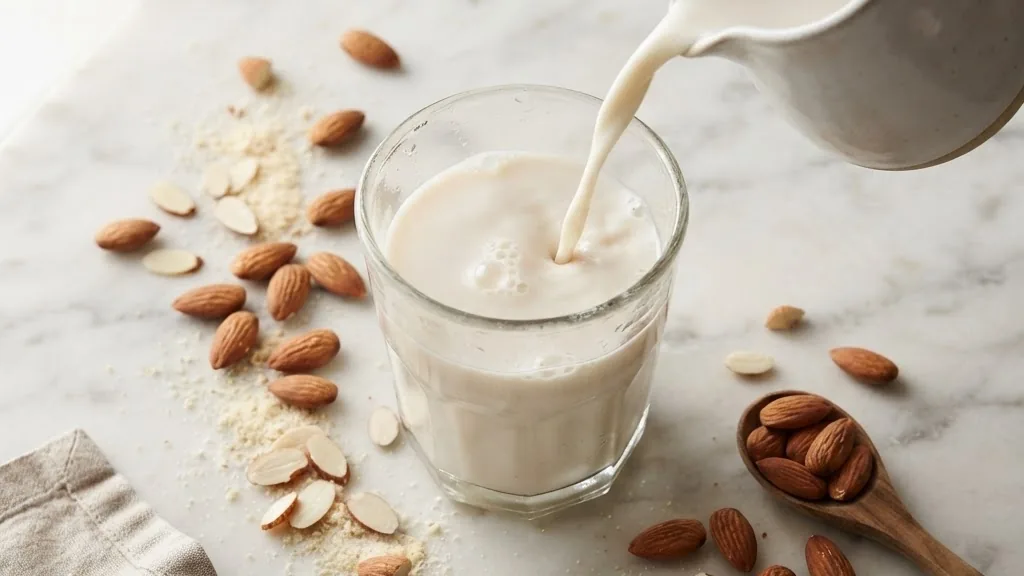
Gluten is a protein found in wheat, barley, and rye. Almonds are tree nuts, and water is water, so the base recipe for almond milk has no gluten source at all. At its simplest, almond milk is blended almonds and water with the solids strained out. Nothing in that process introduces a gluten grain.
This is why almost every plain, unsweetened almond milk is naturally safe to drink on this kind of diet. The trouble only starts when a brand turns that two-ingredient base into a sweetened, flavored, shelf-stable product with a longer ingredient list. Each addition is another chance for gluten to appear, either as an ingredient or as cross-contact during manufacturing.
It also helps to know that the almond content of commercial almond milk is often quite low, sometimes only around 2 percent almonds with the rest being water, added nutrients, and stabilizers. That dilution is a nutrition talking point, but for gluten it is reassuring: the bulk of the carton is water, and water carries no gluten. The risk, again, lives entirely in the handful of added ingredients, not in the almond-and-water foundation.
For context on the nutrition side, an unsweetened almond milk typically runs about 30 to 40 calories per cup with roughly 1 gram of protein, and many brands fortify it to deliver around 45 percent of the daily value for calcium and about 25 percent for vitamin D per serving. None of those added nutrients introduces gluten, but they explain why the ingredient list is longer than the two-item homemade version.
Where gluten can sneak in
If you are sensitive, these are the spots to watch on a carton of almond milk.
- Malt flavoring or malt extract. Usually derived from barley, a gluten grain. This is the single most common hidden source, and it shows up in some chocolate and vanilla varieties.
- Thickeners and stabilizers. Ingredients like carrageenan, gellan gum, and locust bean gum are gluten free in themselves, but they are sometimes processed on shared equipment.
- Added flavorings. Vague “natural flavors” can, rarely, use a gluten-containing carrier. Certified products screen for this.
- Shared facilities. A plant that also runs oat milk or grain-based products can introduce trace gluten through cross-contact, even into an otherwise clean recipe.
None of this means flavored almond milk is automatically off-limits. It means flavored almond milk is where you slow down and read.
The malt-flavor trap
Malt deserves its own section because it is easy to miss. Malt, malt extract, malt syrup, and malt flavoring are typically made from barley. Barley contains gluten, so any of these words on an almond milk carton is a red flag for anyone avoiding gluten. The Celiac Disease Foundation lists barley malt among the sources of gluten people often overlook.
The catch is that malt rarely appears in plain almond milk. It is the flavored versions, especially chocolate and some dessert-style or seasonal flavors, where it can turn up to deepen the taste. If you stick to plain or simply sweetened almond milk, you almost never encounter it. When you reach for a flavored carton, the malt check is the one that matters most.
Fortification, emulsifiers, and other worries you can drop
A long ingredient list can look alarming when you are scanning for gluten, so it helps to know which additions are not a concern. Most commercial almond milk is fortified and stabilized, and the usual suspects are gluten free.
- Added vitamins and minerals, such as calcium carbonate, vitamin D, vitamin E, and vitamin B12, are not gluten sources.
- Emulsifiers and gums, including sunflower lecithin, gellan gum, and locust bean gum, are gluten free in themselves.
- Sea salt and small amounts of cane sugar are fine; sugar is not a gluten grain.
- The almonds themselves are never the problem. There is no gluten in a tree nut, so “almond” on the label is reassuring, not a risk.
Knowing what to ignore is half the skill. It keeps you focused on the two things that actually matter, malt-type flavorings and facility cross-contact, instead of being spooked by a normal fortified formula. If you also avoid dairy, the comparison of almond milk versus cow milk covers the nutrition side of the same carton.
How to read the label safely
Reading an almond milk label takes about ten seconds once you know the pattern.
- Scan the ingredient list for grain words. Malt, barley, wheat, rye, and oats are the ones to flag. Plain almond milk should have none of them.
- Read the allergen statement. Look for a “contains wheat” warning or a “may contain” or “made in a facility with” note that mentions gluten grains.
- Check for a gluten-free claim. A clear “gluten-free” on the package is doing regulatory work, not just marketing, as the next section explains.
- Be extra careful with flavors and blends. Vanilla, chocolate, and almond-oat blends are the ones most likely to introduce a grain.
If you already shop this way for other foods, the same instinct from articles like whether tofu is gluten free carries straight over to plant milks.
Certified gluten-free versus a label claim
There is a meaningful difference between a product that says “gluten-free” and one that is certified gluten-free, and it comes down to testing.
In the United States, the FDA gluten-free labeling rule says a product labeled “gluten-free” must contain less than 20 parts per million (ppm) of gluten. That threshold is widely recognized as safe for most people with celiac disease. So the claim alone already means something.
Certification goes a step further. A certified product has gone through independent testing, often to the same under-20-ppm standard or stricter, and been audited by a third party. The Celiac Disease Foundation recommends certified products for people who need the highest confidence. For nutrition details on the milk itself, you can cross-check values through USDA FoodData Central.
Almond milk versus oat milk
If you are choosing a plant milk specifically to avoid gluten, almond milk is the safer default, and oat milk is the one to scrutinize.
Oats do not contain gluten by nature, but they are frequently grown beside wheat and barley and processed on shared equipment, so plain oat milk carries a real cross-contact risk unless it is made from certified gluten-free oats. Almond milk has no such built-in problem; its base is a tree nut, not a cereal grain. That does not make almond milk automatically certified, but it starts from a much safer place. When in doubt between the two, almond milk is the lower-risk pick.
Here is how the common plant milks stack up for gluten risk before you even read a specific brand.
| Plant milk | Natural gluten? | Main risk | Default safety for gluten-free |
|---|---|---|---|
| Almond milk (plain) | None | Additives, flavorings | High |
| Soy milk (plain) | None | Shared facilities | High |
| Coconut milk (plain) | None | Additives | High |
| Rice milk (plain) | None | Some use barley enzymes | Medium-high |
| Oat milk | None, but high cross-contact | Oats grown and milled near wheat | Low unless certified |
The pattern is clear: nut, seed, and legume milks start safer than grain milks. For a wider view of where gluten hides across the diet, see whether vegan food is gluten free.
What about coffee-shop and barista almond milk?
The almond milk in your latte deserves a separate look, because you cannot always read the carton. Two things change at a cafe.
- Barista blends have more ingredients. They are formulated to foam and resist curdling, which means extra stabilizers and sometimes flavor additions. More ingredients means more to verify.
- Shared equipment is everywhere. The same steaming wand and pitchers may touch oat milk, and pastries with wheat sit right there. For non-celiac sensitivity this is usually a non-issue; for celiac disease it is worth asking the barista which brand they pour and whether they can use a clean pitcher.
If you are strict, the safest move is to ask for the carton or stick to a brand you have already vetted. Most major barista almond milks are gluten free, but “most” is not “all,” and a quick question removes the doubt.
Using almond milk in gluten-free recipes
Once you have a gluten-free almond milk you trust, it becomes one of the most useful staples in a gluten-free kitchen. It behaves much like dairy milk in most recipes, which is why it slots in so easily.
- Baking: swap it one-to-one for dairy milk in gluten-free muffins, pancakes, and quick breads. The unsweetened version keeps you in control of the sugar.
- Sauces and soups: it thickens gently and works in creamy gluten-free sauces, though it is thinner than canned coconut milk, so reduce a little longer for body.
- Smoothies and oats: a natural base for breakfast bowls, especially with certified gluten-free oats.
- Coffee and tea: fine for everyday use; reach for a barista version only if you want microfoam.
The one habit to keep is consistency: pick a plain, gluten-free-labeled almond milk as your cooking workhorse so you are not re-checking a new carton every time you bake. That single choice removes most of the day-to-day worry.
Celiac disease versus gluten sensitivity
How strict you need to be depends on why you are avoiding gluten.
If you have celiac disease, even trace gluten can trigger an immune response and intestinal damage, so the certified gluten-free label and a careful facility check are worth the effort. Stick to plain or certified products and treat any malt or “may contain” note as a stop sign.
If you have non-celiac gluten sensitivity, you likely have more room. Plain almond milk is almost always fine, and you can make a judgment call on flavored versions based on how you react. Either way, the label-reading habit protects you, and it costs nothing.
Homemade almond milk: the zero-risk option
When you want total control, make it yourself. Homemade almond milk is the only version where you know every ingredient.
- Soak about 1 cup of raw almonds in water overnight, then drain.
- Blend the almonds with 3 to 4 cups of fresh water, a roughly 1 to 3 or 1 to 4 ratio depending on how rich you like it.
- Strain through a nut-milk bag or fine cloth to remove the pulp.
- Sweeten or flavor to taste, using a date, a splash of vanilla, or a pinch of salt, all of which you control.
It keeps in the fridge for about three to four days and removes every question about malt, additives, and shared facilities at once. Shake it before each use, since homemade almond milk separates without the commercial stabilizers. If you want it richer for coffee, use the 1 to 3 ratio; for a lighter drinking milk, go closer to 1 to 4. Save the leftover almond pulp for baking or oatmeal so nothing goes to waste. For most people this is overkill, but if you have celiac disease and want one source you never have to second-guess, the homemade route is the most certain answer to the whole question.
What store-bought brands tell you
No brand stays the same forever, because recipes change, so always read the current carton. But there are reliable patterns worth knowing as you shop.
Plain and unsweetened lines are the safest bet. Across almost every major almond milk brand, the plain and unsweetened versions have the shortest, cleanest ingredient lists and are the most likely to be labeled or certified gluten free. When a brand offers a gluten-free certification, it usually applies to these core products first.
Flavored, sweetened, and “holiday” versions need a second look. This is where malt, extra natural flavors, and richer formulations appear. A chocolate or cookie-flavored almond milk is not likely to be gluten free by default the way the plain version is.
Store brands can be just as safe as name brands, as long as the label carries the gluten-free claim. Price is not a proxy for safety here; the label and certification are. The habit that protects you is the same one you would use for any packaged food, like checking whether hummus is gluten free before you assume.
Common mistakes
- Assuming all almond milk is identical. Plain and flavored versions can have very different ingredient lists.
- Ignoring the allergen statement. The ingredient list can look clean while a “made in a facility with wheat” note tells the real story.
- Trusting “natural” as a safety word. Natural flavors are not automatically gluten free; certification is what verifies them.
- Treating oat milk and almond milk as equally safe. They are not, for gluten purposes.
- Skipping certification when you have celiac disease. The plain claim is good; certification is better when the stakes are high.
Frequently asked questions
Is unsweetened almond milk gluten free?
Almost always, yes. Unsweetened versions have the shortest ingredient list, usually almonds, water, and a stabilizer or two, with no problem ingredient. Still glance at the allergen statement if you have celiac disease.
Is vanilla or chocolate almond milk gluten free?
Often, but these are the versions where malt and added flavorings can introduce gluten. Check the ingredient list for malt and look for a gluten-free label before assuming.
Is almond milk safe for celiac disease?
Plain almond milk generally is, and a certified gluten-free product is the safest choice. Because celiac disease reacts to even trace amounts, certification and a facility check give you the most confidence.
Are carrageenan and gellan gum gluten free?
Yes, both are safe in themselves. The only caveat is potential cross-contact if they are processed alongside wheat or barley, which certification rules out.
Is almond-oat blend milk gluten free?
Treat it with the same caution as oat milk. Unless the oats are certified gluten free, an almond-oat blend carries the cross-contact risk that comes with oats.
Does the 20 ppm rule apply to almond milk?
Yes. Any product sold in the United States with a u0022gluten-freeu0022 label, including almond milk, must contain less than 20 parts per million of gluten under the FDA rule.