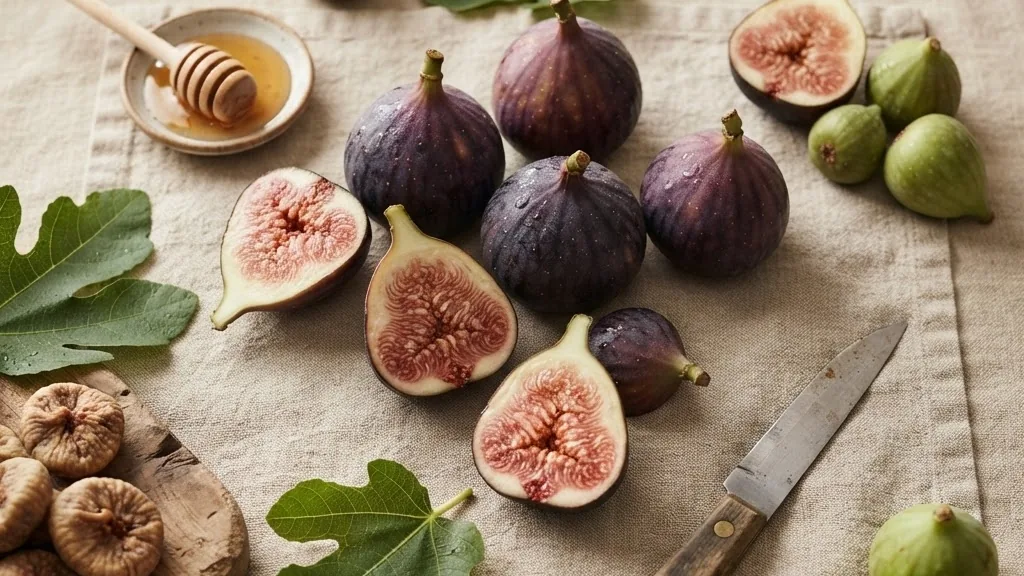
Are figs vegan is one of the few food questions that makes people who have been plant-based for a decade suddenly hesitate at the produce aisle. The reason is a strange bit of biology involving a wasp, an inverted flower, and an enzyme most of us have never heard of. The question comes up often, partly because of a viral clip claiming every fig contains a dead insect. So here is what actually happens inside a fig, what The Vegan Society says, and which figs never touch a wasp at all.
Sourced from The Vegan Society’s published definition and the Alabama Cooperative Extension System fig production guide, with the wasp biology cross-checked against horticultural references.
Quick answer: Are figs vegan? Yes. Nearly all vegans, including The Vegan Society, treat figs as vegan. Many common figs sold fresh in the United States, such as Black Mission, Brown Turkey, and Kadota, are parthenocarpic, meaning they set fruit with no wasp involved at all. Even the varieties that do rely on a fig wasp contain no wasp body when you eat them, because the fig produces an enzyme called ficin that fully breaks the insect down into protein. The crunch you feel is seeds, not wasps. A small number of vegans still choose to skip wasp-pollinated types as a personal ethic.
Why This Question Even Exists
A fig is not a fruit in the way an apple is. Botanically it is a syconium: a fleshy, hollow structure lined on the inside with dozens of tiny flowers that bloom facing inward. Nothing can reach those flowers from the outside the way a bee reaches an open blossom. That inside-out design is the whole problem, and the whole reason a specialized insect entered the picture over at least 60 million years of co-evolution. The genus Ficus is enormous, roughly 750 species worldwide, and nearly every one has evolved its own dedicated wasp partner, which is often cited as the most extreme case of specialization in any plant-pollinator relationship.
The pollinator for the common fig, Ficus carica, is a fig wasp called Blastophaga psenes. It is tiny, only about 2 mm long, roughly the size of a grain of rice, and its entire life is tangled up with the fig. When people hear that, they picture biting into a wasp. That is not what happens, and understanding why takes about two paragraphs of biology that most viral videos skip.
What Actually Happens Inside a Fig
Here is the cycle for a fig that does depend on a wasp. A female fig wasp, already carrying pollen from the fig where she hatched, finds a receptive fig and crawls in through a tiny opening at the tip called the ostiole. That passage is so narrow it usually tears off her wings and antennae on the way in. She cannot leave. Inside, she pollinates the flowers and lays her eggs, then she dies.
This is where the part everyone misses comes in. The fig then produces ficin, a protein-digesting enzyme found in the fruit’s walls. Ficin breaks the wasp’s body down into protein, so that no part of the wasp remains by the time the fig ripens. There is no carcass, no wing, no “wasp meat” waiting for you. The fig has, in effect, absorbed her. Her offspring hatch, mature, mate, and the new females fly off carrying pollen to start the cycle again.
The male and female wasps live very different lives, and that difference is worth understanding because it explains how the pollen ever gets out. Male fig wasps are wingless and nearly blind. They are born inside the fig, never leave it, and have one job: to mate with the females while both are still developing inside the same fig, then to chew exit tunnels through the fig’s wall. Once that work is done, the males die inside.
The females, by contrast, emerge from their egg galls, crawl out through those tunnels, and in the process brush past the fig’s male flowers and pick up a fresh dusting of pollen. They fly off to find a new receptive fig, and the whole loop repeats. So the wasp that enters and dies is always a female, and the fig she dies in is either a caprifig, where her young will develop, or an edible Smyrna fig, where she pollinates but her eggs cannot mature. That distinction is the hinge of the entire system.
It also clears up a common confusion: the fig you buy at the store is not the same fig where the wasps breed. Wasps reproduce inside caprifigs, the inedible male-function figs. When a female wanders by mistake into an edible Smyrna-type fig, she pollinates it but cannot lay viable eggs there, and ficin does the rest. So even in the wasp-dependent varieties, the fruit on your plate is not a nursery full of larvae. It is a pollinated fruit whose lone visiting wasp has been chemically dismantled.
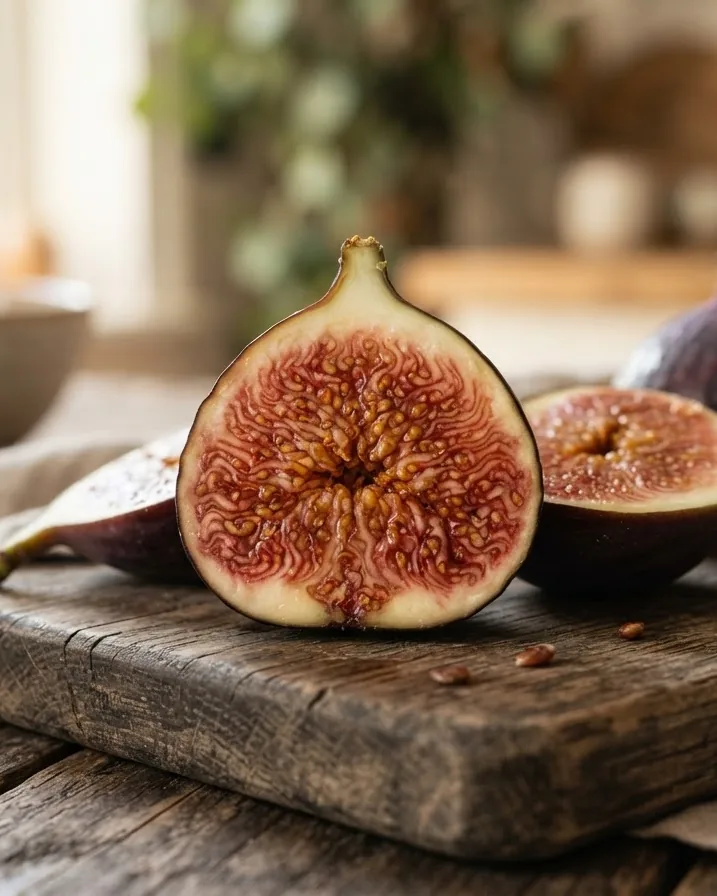
So when someone tells you the crunchy bits in a fig are wasp parts, they are wrong. According to the fig biology laid out by Vegan Food and Living, the crunchy bits are seeds, not the remains of wasps. Split open a fig and what you see under a knife is jam-like flesh packed with pale seeds. That is the crunch. Nothing else.
The Enzyme Doing the Heavy Lifting: Ficin
Ficin deserves its own moment because it settles most of the argument. It is a proteolytic enzyme, meaning it cleaves proteins apart. The same class of enzyme is used commercially as a meat tenderizer and shows up in some traditional cheese-making. Inside the fig, ficin is also why unripe fig sap can leave a tingly, almost raw feeling on your lips and tongue. When a wasp dies inside a pollinated fig, ficin does not leave a tidy little insect in there. It dismantles the tissue at the molecular level.
That matters for the vegan question in a concrete way. Veganism, as most people practice it, is about not consuming animal bodies or animal exploitation. A fig contains no recognizable animal body. What it contains is plant tissue, seeds, and sugars, plus, in wasp-pollinated types, some protein that once belonged to an insect but no longer exists as an insect in any meaningful sense. For scale, USDA figures put 100 grams of fresh figs at about 74 calories with roughly 16 grams of naturally occurring sugar, so what you are eating is overwhelmingly fruit, not insect.
Most Figs You Buy Never Meet a Wasp
Now the part that surprises almost everyone. A large share of the figs sold fresh in the United States do not need a wasp at all. According to the Alabama Cooperative Extension System, edible figs fall into three pollination groups, and the biggest one for home growers and grocery shelves needs no pollination whatsoever.
- Common or persistent figs do not need pollination to set crops. They fruit parthenocarpically, meaning the fruit develops without fertilization. Black Mission, Brown Turkey, Celeste, Brunswick, and Adriatic are all this type.
- Smyrna or caducous figs need pollination or the fruit drops before it matures. Caprifigs supply the pollen through the wasp. Calimyrna, Marabout, and Zidi are examples.
- San Pedro or intermediate figs set an early breba crop on old wood without pollination, but need it for the main crop in some climates. King, Lampeira, and San Pedro fall here.
The caprifig itself, the wild fig that hosts the wasp brood and hands over the pollen, is generally inedible and is not what gets sold as fruit. So the wasp cycle lives largely in a fig you would never eat, working to pollinate the Smyrna types that do end up on shelves as, most famously, Calimyrna.
It is worth being precise about what “commercial” means here, because the panic usually assumes every fig on earth runs on wasps. In the fresh US market, the workhorses are common types: Black Mission, Brown Turkey, and Kadota dominate grocery displays, and all three fruit without pollination. Calimyrna, the wasp-dependent Smyrna type, is real and widely sold, but it is one lane of the market rather than the whole road.
The name is a giveaway: Calimyrna is a contraction of California and Smyrna, the Turkish region that gave the wasp-pollinated fig its name. When California growers wanted to produce those figs, they famously had to import the Blastophaga wasp along with the caprifigs, because the fig would not fruit without its partner. That is how deliberately absent the wasp is from every common-type fig.
A Variety-by-Variety Table
This is built from the Alabama Extension pollination classes plus what actually turns up at US markets. If you want a fig that categorically never involved a wasp, stay in the “Common” rows.
| Fig variety | Pollination type | Needs wasp pollination? | Vegan-friendly? |
|---|---|---|---|
| Black Mission | Common / persistent | No (parthenocarpic) | Yes |
| Brown Turkey | Common / persistent | No | Yes |
| Celeste | Common / persistent | No | Yes |
| Adriatic | Common / persistent | No | Yes |
| Kadota | Common type | No | Yes |
| Calimyrna | Smyrna / caducous | Yes, via caprifig wasp | Yes by Vegan Society standard; some skip by choice |
| King / San Pedro | Intermediate | Main crop may need it | Mostly; breba crop needs none |
One practical note on dried figs, since that is where wasp-pollinated types are most likely to be in your pantry. Golden dried figs are usually Calimyrna, the Smyrna-type that does rely on the wasp. Dark dried figs are usually Mission, a common type that does not. If it matters to you, the color is a decent first clue, though the bag rarely spells out the pollination method.
Drying also changes the math on what you are tasting. Fresh figs are about 79 percent water, while dried figs drop to roughly 30 percent, which is why the sugar reads so much more intensely in a dried fig even though nothing was added. Both are worth keeping in the pantry, and they suit different uses. The dark Mission figs are chewier and jammier once dried, and they hold up in oatmeal, energy bites, and long-braised grain dishes without turning to mush. The golden Calimyrna figs are softer and a little nuttier, and they work well chopped raw into salads or simmered briefly into a compote.
If you are shopping strictly wasp-free, buy the dark Mission bag and you are done. If you follow the standard vegan definition, buy whichever tastes better to you, because both are vegan. Either way, check the ingredient list for one real catch: some dried figs are dusted with rice flour or coated in ingredients you may want to verify, and a few brands sweeten or glaze them. The pollination method is never the ingredient that makes a dried fig non-vegan; an added coating occasionally is.
What The Vegan Society Actually Says
The cleanest way to answer whether figs are vegan is to go back to the definition vegans actually use. According to The Vegan Society, veganism is “a philosophy and way of living which seeks to exclude, as far as is possible and practicable, all forms of exploitation of, and cruelty to, animals for food, clothing or any other purpose.”
The load-bearing phrase is “as far as is possible and practicable.” Vegans are not claiming to live in a sealed bubble where no insect is ever affected by their food. A tractor harvesting lentils affects insects. So does the pollination of almonds. The standard is about deliberate exploitation and cruelty, and about doing what is reasonably in your control. The fig-wasp relationship is a natural symbiosis that predates agriculture by millions of years. No human is farming or killing wasps to make your Black Mission fig. On that reading, figs are vegan, and that is the position The Vegan Society and mainstream vegan organizations take.
This is the same logic that shows up in the honey debate, which lands differently precisely because honey involves managed hives and deliberate harvesting. If you want to see how the reasoning shifts when humans are actively directing the insects, our breakdown of whether honey is vegan is a useful companion read. And if you are still nailing down where the lines sit in the first place, our plain-language guide to what vegan means covers the definition in full.
The Honest Nuance: Personal Choice
The vegan community is not unanimous on this, and the real picture matters more than a tidy answer. A minority of vegans choose to avoid wasp-pollinated figs specifically, the Smyrna and Calimyrna types, because a wasp does die inside them as part of the cycle. That is a considered ethical position, and it deserves respect. It is also a personal one, not a ruling handed down by any major vegan authority.
My own read, after years of testing plant-based recipes, is this. If the death of an insect through a natural pollination process crosses your personal line, you have an easy and complete solution: buy common-type figs, which never involve a wasp at all. Black Mission and Brown Turkey are the two you will find most often fresh, and they are parthenocarpic. You lose nothing, flavor-wise. If instead you follow the standard vegan definition, all figs are fair game, including Calimyrna.
What does not hold up is the viral framing that figs are secretly non-vegan or full of insects. That is not accurate. It confuses a fascinating piece of biology with a plate of bugs, and it scares people off a genuinely good whole food. Figs are one of those hidden-ingredient reveals that turns out to be far less alarming than the headline, a bit like discovering what really sets certain gummy desserts. If that kind of reveal interests you, our look at whether jello is vegan covers a case where the animal ingredient truly is in the product.
How to Buy and Cook Figs
Practically, figs remain a late-summer staple, and none of the wasp discourse changes that. Fresh Black Mission figs, halved and roasted at 400 degrees F for about 15 to 20 minutes until they slump and caramelize, make one of the simplest desserts there is. A drizzle of maple instead of honey keeps it fully plant-based. Dried Mission figs go into oatmeal, energy bites, and grain salads.
- For fresh figs with zero wasp involvement, ask for or look for common types: Black Mission, Brown Turkey, Celeste, Adriatic, or Kadota.
- For dried figs, dark ones are typically Mission (common type); golden ones are typically Calimyrna (wasp-pollinated Smyrna type).
- Store fresh figs in the fridge and use them within a couple of days, since they bruise and ferment fast once ripe.
- If the sap from a slightly underripe fig stings your lips, that tingle is ficin, the same enzyme that dismantles the wasp. It fades as the fruit fully ripens.
The bigger point is that fig trees are worth knowing well if you eat plants. According to the Alabama Cooperative Extension System, mature fig trees are cold hardy down to roughly 15 to 20 degrees F, which is why hardy common types like Celeste and Brown Turkey thrive for backyard growers across a wide swath of the country, all of them wasp-free by design.
Frequently asked questions
Do all figs contain dead wasps?
No. Common or persistent figs like Black Mission, Brown Turkey, and Kadota are parthenocarpic and never involve a wasp. Even in wasp-pollinated Smyrna types, the enzyme ficin breaks the insect down so no wasp body remains in the ripe fruit.
Are figs vegan according to The Vegan Society?
Yes. The Vegan Society defines veganism as excluding animal exploitation “as far as is possible and practicable.” The fig-wasp cycle is a natural symbiosis, not human exploitation, so figs are treated as vegan.
Are the crunchy bits in figs wasps?
No, they are seeds. Fig biology explainers are clear that the crunch is the fig’s many tiny seeds, not insect remains. Ficin dissolves any wasp that dies inside a pollinated fig.
Which figs are guaranteed wasp-free?
Common-type figs: Black Mission, Brown Turkey, Celeste, Adriatic, and Kadota. Per the Alabama Cooperative Extension System, these set fruit without any pollination, so no wasp is ever involved.
Is Calimyrna fig vegan?
By the standard vegan definition, yes. Calimyrna is a Smyrna-type fig that does need a fig wasp via caprifigs, and some vegans choose to skip it for that reason, but it contains no wasp body and most vegans consider it vegan.
What is ficin and why does it matter here?
Ficin is a protein-digesting enzyme in figs. It breaks down the wasp so nothing recognizable remains, and it is also the source of the tingly sensation from unripe fig sap. It is central to why figs count as vegan.
Sources: The Vegan Society (official definition of veganism); Alabama Cooperative Extension System, Fig Production Guide (Auburn University); Vegan Food and Living (fig-wasp and ficin explainer).