Is vegan dairy free? Yes. If a food is genuinely vegan, it is automatically dairy free, because dairy is an animal product and vegan means no animal products at all. That is the clean half of the answer. The messy half, and the reason to read two different parts of a label, is that it does not work in reverse: plenty of foods stamped “dairy free” are not vegan, a gap that regularly catches shoppers at the grocery store.
The definitions and label facts below come from named nutrition and food-safety authorities and from current US allergen labeling rules, not from memory.
Quick answer: Every vegan food is dairy free, but not every dairy free food is vegan. “Vegan” excludes all animal products, which sweeps up milk, cheese, butter, cream, whey, and casein along with meat, eggs, and honey. “Dairy free” only excludes milk and things made from milk, so a dairy free cookie can still contain egg, honey, gelatin, or an insect-derived color. When your only concern is milk, a vegan label is the strongest guarantee you can get. When you are vegan, a dairy free label is a starting point that still needs a second look.
The short answer, and the trap inside it
Think of it as two circles. The vegan circle sits entirely inside the dairy free circle. Everything in the vegan circle is also dairy free, but the dairy free circle is much bigger and holds a lot of foods a vegan would put straight back on the shelf. That single geometry answers most of the confusion around these two words.
The reason it matters is that the two labels are answering different questions. Vegan is answering “does this involve any animal.” Dairy free is answering the much narrower “does this involve milk.” A carton of honey-sweetened almond yogurt is dairy free and not vegan. A dark chocolate bar can be dairy free on paper and still be filtered with something you would rather avoid. Once the two phrases stop being treated as synonyms, the label aisle gets a lot less frustrating.
A bag of “dairy free” chewy candy, for example, can still list gelatin partway down. Dairy free, sure. Vegan, not even close. The rule to remember: dairy free tells you what is missing, not what is present.
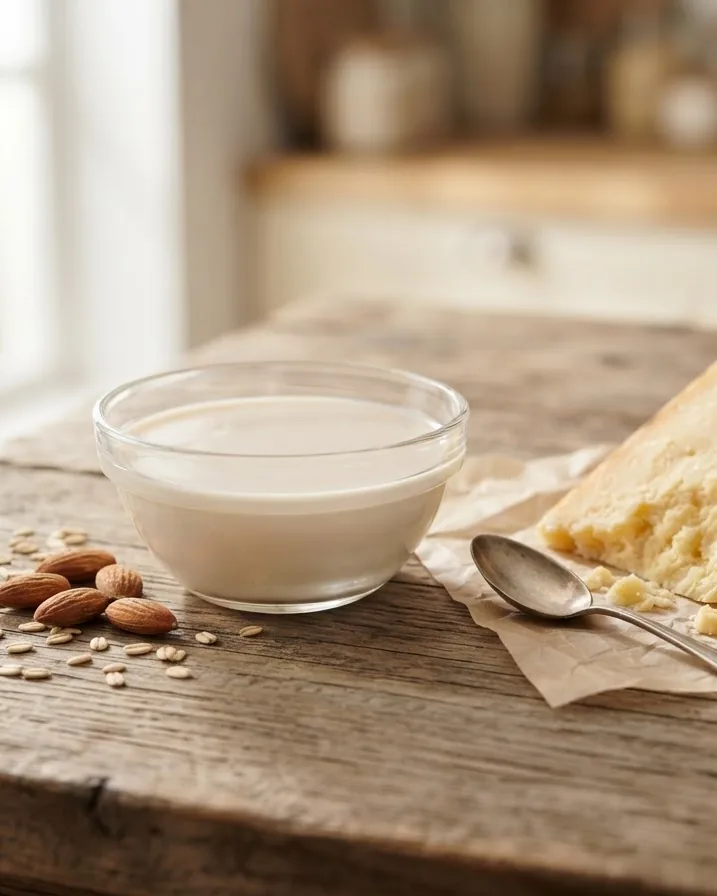
What “vegan” actually rules out
Veganism is broader than a shopping filter. The Vegan Society defines it as a way of living that seeks to exclude, as far as is practicable, all forms of animal exploitation and cruelty, whether for food, clothing, or any other purpose. In food terms that draws a hard line around a specific list: no meat, no poultry, no fish or shellfish, no eggs, no dairy in any form, and no honey. Many vegans also skip gelatin, carmine, isinglass, and lard, because all of those come from animals too.
Because dairy is one item on that no list, a real vegan product cannot contain milk, cheese, butter, cream, ghee, whey, casein, or lactose. That is why the moment a food earns the vegan label, the dairy question is already settled. You do not need to double-check for milk on a certified vegan product, because milk was excluded to get the label in the first place.
Veganism also reaches past the plate. It shapes choices about leather, wool, down, and cosmetics that involve animal testing. None of that changes the dairy answer, but it explains why “vegan” is a stronger, wider claim than “dairy free” will ever be. If the vegan vs vegetarian line is also fuzzy for you, this guide to the difference between vegan and vegetarian untangles those two, because the same “which animal products are out” logic drives all three labels.
What “dairy free” actually rules out
Dairy free is a much smaller promise. It means the food contains no milk and nothing made from the milk of any animal, so no cow, goat, or sheep milk, and none of the products that come from that milk: cheese, yogurt, butter, cream, ice cream, whey, casein, or lactose. That is the whole scope. It says nothing about eggs, honey, meat, fish, or insect dyes.
People choose dairy free for reasons that usually have nothing to do with animal welfare. The big two are medical. A cow’s milk allergy, an immune reaction to milk protein, affects an estimated 2 to 3 percent of infants, though most children outgrow it. Lactose intolerance, the inability to fully digest milk sugar, is far more common: widely cited figures put it at roughly 65 to 70 percent of the world’s adult population to some degree. Someone managing either of those can happily eat a steak or a scrambled egg, which is exactly why dairy free and vegan are not the same eating pattern.
One more wrinkle worth knowing: in the United States, “dairy free” is not a term the FDA formally defines or regulates. Even “non-dairy” is loose enough that, by long-standing rule, a non-dairy coffee creamer can legally still contain the milk protein casein. So the label is helpful, but it is not a locked guarantee the way the allergen statement is.
Why all vegan is dairy free but not the reverse
Here is the logic laid out plainly, because it is the heart of the whole question. Vegan is a superset of dairy free restrictions. To be vegan, a food must clear a long list of exclusions, and dairy is only one of them. So passing the vegan test automatically means passing the narrower dairy test. You cannot be vegan and contain milk, by definition.
Going the other way breaks down instantly. A food can pass the dairy test, containing no milk at all, while failing several other vegan tests. Honey is the classic example. Gelatin is another. Egg whites, carmine coloring, and animal fats all sail through a dairy free screen and stop a vegan cold. That is the asymmetry in one sentence: removing milk does not remove every animal, but removing every animal does remove milk.
If you want a mental shortcut at the shelf, use this: a vegan claim answers the dairy question for you, but a dairy free claim leaves the vegan question wide open. Trust the broader label to cover the narrower need, never the other way around.
The dairy words that hide on labels
Milk does not always announce itself with the word milk. This is where a lot of accidental slip-ups happen, even for people who read panels carefully. These are the dairy-derived ingredients worth scanning for specifically, because their names give little away:
- Whey: the liquid left after milk is curdled, dried into powder. It hides in chips, crackers, bread, protein bars, and chocolate. This is the one the eye slides past most often.
- Casein, caseinate, sodium or calcium caseinate: the main milk protein. It is the ingredient that keeps some “non-dairy” creamers technically non-vegan and not truly milk-free.
- Lactose and lactalbumin: milk sugar and a milk protein, used as fillers and in some flavorings.
- Ghee, milk solids, milk fat, curds: straightforward dairy under slightly disguised names.
The fastest reliable tool for catching all of these is not the front of the box, it is the allergen line. Under the US Food Allergen Labeling and Consumer Protection Act, milk is one of the major allergens that must be plainly declared, so a packaged food that contains any milk-derived ingredient has to say “Contains: milk” (or name milk in the ingredient list). Sesame joined that required list as the ninth major allergen on January 1, 2023, which shows how seriously that declaration is enforced. For the milk question specifically, that legally required line is more trustworthy than the marketing on the front.
Dairy free foods that still are not vegan
This is the category that trips up new vegans, because these foods pass the milk test with flying colors and still involve an animal. If you are avoiding dairy for a milk allergy, none of these are a problem. If you are vegan, every one of them is a hard stop.
Honey is the most common. It is made by bees, so it is an animal product under the vegan definition, yet it is completely dairy free. It shows up in granola, dairy free yogurts, teas, and “natural” candies constantly. This guide to whether honey is vegan breaks down the full reasoning on bees, because it is the single ingredient that catches the most people.
Gelatin is next. It is made by boiling animal collagen from skin and bones, and it is the setting agent in gummies, marshmallows, some yogurts, and many chews. Dairy free, absolutely. Vegan, no.
Eggs are obvious once you think about it, but they slide past a dairy scan easily because eggs are not dairy in the first place. A dairy free baked good can be full of egg. Carmine or cochineal is a red coloring made from crushed insects, common in red drinks, candies, and some yogurts. Lard and tallow are animal fats. Isinglass, from fish bladders, is used to fine some wines and beers, so a drink can be dairy free and still not vegan. None of these contain a drop of milk, and all of them are off the vegan list.
An original label cheat sheet: which claim covers what
This table is built from the definitions and labeling rules so you can see at a glance what each word actually promises. The pattern is the whole point: vegan covers everything dairy free covers, plus a lot more.
| Ingredient | Dairy free? | Vegan? |
|---|---|---|
| Cow, goat, or sheep milk | No | No |
| Whey / casein / lactose | No | No |
| Butter, cheese, cream, ghee | No | No |
| Honey | Yes | No |
| Gelatin | Yes | No |
| Egg / egg white | Yes | No |
| Carmine / cochineal | Yes | No |
| Lard / tallow | Yes | No |
| Fortified soy or oat milk | Yes | Yes |
| Beans, grains, vegetables, fruit | Yes | Yes |
Notice that the No/No rows are all dairy, and the Yes/No rows are all the other animal products. That middle band, dairy free but not vegan, is exactly the zone where accidental purchases happen. Keep those six rows in your head and you will catch almost every mismatch.

Reading a label in ten seconds
After enough grocery runs this became a reflex. Here is the exact scan to run, and it changes depending on what you are actually screening for.
- If you only care about dairy: jump straight to the “Contains” line and look for milk. If it is absent and you see no whey, casein, or lactose in the list, you are dairy free. Done.
- If you are vegan: that same milk check is only step one. Now sweep the ingredient list for honey, gelatin, egg, carmine or cochineal, and any animal fat. Any hit ends it, milk or not.
- Trust the vegan certification if it is there. A certified vegan logo means the dairy question is already answered, so you can skip straight past the milk hunt.
- Treat “non-dairy” with mild suspicion. It can legally still carry casein, so read the panel rather than the front.
The habit that saves the most time: decide before picking up the box which question you are asking. Am I avoiding milk, or avoiding all animals? The answer tells you which part of the label to trust, and it stops you from treating a dairy free stamp as a vegan pass.
Swapping dairy without losing calcium or protein
Whether you are dairy free by necessity or vegan by choice, the practical worry is the same: am I giving up the nutrition milk was providing. The good news is that a smart swap covers it. One cup of dairy milk delivers about 8 grams of protein and roughly 300 mg of calcium. Many fortified plant milks are built to match that calcium, landing in the same 300 mg to 450 mg range per cup. Soy or pea milk carries about 7 grams of protein per cup, and often a full 8 grams, so they close the protein gap that almond and oat milk leave open.
The Harvard T.H. Chan School of Public Health notes that fortified soy milk is the plant milk that comes closest to cow’s milk nutritionally, which makes it the default choice for anything where milk was doing real nutritional work, like a morning smoothie or a bowl of cereal. Oat and almond are lovely for coffee and baking, but they are not a protein source to count on.
One nutrient no plant makes on its own is vitamin B12, so vegans in particular should get it from fortified foods or a supplement, with an adult RDA around 2.4 micrograms per day. That is a vegan concern rather than a dairy free one, since a dairy free eater who still has eggs, fish, or meat is already covered. It is a good example of how the two diets diverge once you look past the milk aisle. For practical swaps, this vegan egg substitute guide covers the baking side of going fully animal-free.
Where the two labels collide when you eat out
The grocery aisle is the easy case, because packaged food has a panel. Restaurants are where the vegan and dairy free distinction gets slippery, and where conversations with a server can get awkward. A kitchen that hears “dairy free” will confidently hand a vegan a dish cooked in butter substitute but bound with egg, or a “dairy free” dessert sweetened with honey. They answered the question you asked, not the one you meant.
So it pays to ask the vegan question directly rather than the dairy one. Instead of “is this dairy free,” ask “does this have any egg, dairy, or honey in it,” which forces the kitchen to check the three by-products that matter. For a genuine milk allergy the reverse is true: “dairy free” is not specific enough either, because cross-contact with cheese or a splash of cream in a sauce can be a medical problem, not a preference. In that case, name milk as an allergy, which flips the kitchen into a stricter mode than a lifestyle request ever will. The lesson is the same in both directions. Say the specific thing you need excluded, because the words vegan and dairy free carry different assumptions in a busy kitchen, and assumptions are exactly what you cannot afford when it matters.
The one label that settles both questions
If all of this feels like a lot of tracking, there is a shortcut worth knowing: a certified vegan logo answers the dairy question and the animal question in one stamp. Certification means a third party has checked the ingredients and, in many programs, the processing aids, so you do not have to scan for whey, casein, honey, or gelatin yourself. It is the only single label that guarantees both “no milk” and “no animal.”
A dairy free certification, by contrast, only promises the milk half, and it may not catch trace cross-contact levels that a severe allergy requires. So the hierarchy is simple. If you need zero animal products, look for certified vegan first and read the panel second. With a milk allergy, trust the allergen “Contains” line and cross-contact statements over any marketing phrase. Never let a dairy free claim stand in for a vegan one, because the whole point of this article is that the small word covers less than the big one. Keep that order in your head and both the aisle and the menu get a lot less stressful.
Frequently asked questions
Is all vegan food automatically dairy free?
Yes. Because vegan means no animal products of any kind, and dairy is an animal product, anything genuinely vegan cannot contain milk, cheese, butter, cream, whey, or casein. If you only need to avoid dairy, a vegan label is a complete guarantee on the milk question.
Does dairy free mean vegan?
No. Dairy free only means no milk or milk-derived ingredients. A dairy free food can still contain honey, gelatin, egg, carmine, or animal fat, all of which are off-limits for vegans. Always read past the dairy free claim if you are avoiding all animal products.
Can a non-dairy product still contain milk?
Sometimes, yes. In the US, u0022non-dairyu0022 is a loose term, and by long-standing rule a non-dairy coffee creamer can still legally contain the milk protein casein. The reliable check is the allergen line, since milk is a major allergen that must be declared by law.
Why do people choose dairy free instead of vegan?
Usually for medical reasons. Lactose intolerance affects roughly 65 percent to 70 percent of adults worldwide to some degree, and cow’s milk allergy affects about 2 percent to 3 percent of infants. Those eaters need to avoid milk but can still eat meat, eggs, and honey, so dairy free fits them better than full veganism.
What dairy words should vegans watch for on labels?
Whey, casein, caseinate, lactose, lactalbumin, ghee, milk solids, and milk fat. Whey and casein are the sneakiest, showing up in chips, bread, and creamers. The u0022Contains: milku0022 allergen line catches all of them fast.
Will a plant milk give me the same calcium and protein as cow’s milk?
Fortified plant milks can match the calcium, around 300 mg or more per cup. For protein, choose fortified soy or pea milk, which supply about 7 grams to 8 grams per cup, close to dairy’s 8 grams. Almond and oat milk are lower in protein, so pick by nutrient need.nnSources: Healthline, Vegan vs. Dairy-Free (definitions and the overlap rule); The Vegan Society (definition of veganism and animal products including honey); US FDA, food allergen labeling (milk as a major allergen, sesame as the ninth allergen effective January 1, 2023); Harvard T.H. Chan School of Public Health, The Nutrition Source (fortified soy milk, calcium, and vitamin B12 for plant-based eaters).