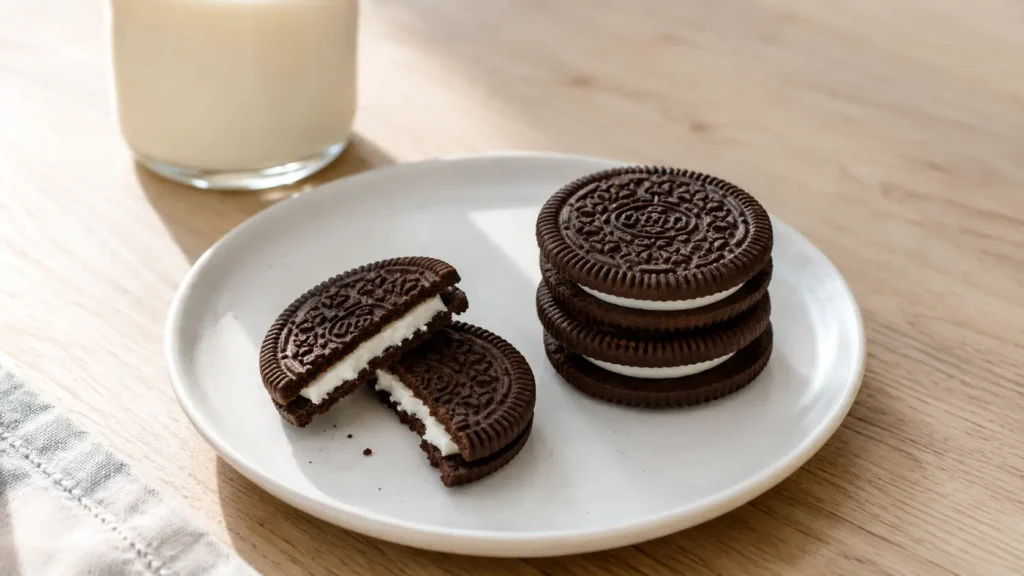
Are Oreos vegan? The short version is yes, with an asterisk: the original Oreo contains no animal ingredients, no milk, butter, eggs, honey, or gelatin, so by its recipe it is plant-based. The catch is that the maker, Mondelez, states Oreos are produced on shared equipment with milk and therefore are “not suitable for vegans” because of possible cross-contact. Most vegans eat them anyway under the movement’s own common-sense standard, while some choose to skip them. And a handful of specialty flavors really do contain dairy, so the label still matters.
That nuance is the whole story, and it is worth understanding rather than memorizing a yes or no. Below is exactly what is in an Oreo, why the cross-contamination warning exists, where vegans tend to draw the line, which flavors to avoid, and the easy homemade route if you would rather sidestep the question entirely.
The Short Answer
Standard Oreos, the classic, and most of the everyday flavors, are made without any animal-derived ingredients, which is why they are so often called “accidentally vegan.” They were never formulated to be vegan; they simply happen not to contain animal products. The reason they are not officially labeled vegan comes down to manufacturing, not the recipe. If you are comfortable with trace cross-contact, original Oreos fit a vegan diet. If you avoid any product that shares a line with dairy, they do not. It is one of those rare cases where the honest answer is genuinely “it depends on your standard,” and the rest of this guide is meant to give you enough detail to set that standard for yourself rather than defer to anyone else’s rule. The good news is that the facts are simple once they are laid out, and they put the decision firmly in your hands.
What Is Actually in an Oreo?
Reading the ingredient list is the most reliable way to answer the question for any given pack, because that is where the truth lives. Here is what the classic Oreo is built from and whether each part raises a flag.
| Ingredient | Animal-derived? | Notes |
|---|---|---|
| Wheat flour, sugar | No | Plant-based staples |
| Palm and/or canola oil | No | Replaces butter; raises an ethical question, below |
| Cocoa (processed with alkali) | No | Plant-based |
| High fructose corn syrup | No | Plant-based sweetener |
| Soy lecithin | No | Emulsifier from soybeans |
| Artificial flavor | No | No dairy in the standard recipe |
Notice what is missing: there is no milk, no butterfat, no whey, and no egg in the standard cookie. The creme filling, which people often assume is dairy, is made from sugar and oil, not cream. On ingredients alone, the classic Oreo is plant-based.
The Cross-Contamination Catch

So why the warning? Oreos are produced in facilities that also handle products containing milk, and the same lines that turn out the plant-based cookies also run dairy-containing varieties. Because the company cannot guarantee that microscopic traces of milk protein never carry over, it declares that Oreos “have milk as an allergen” and are not suitable for people with a milk allergy, and, by extension, not certified vegan. This is a contamination disclosure, not a recipe ingredient. For someone with a true dairy allergy, that warning is a genuine safety issue and should be taken seriously. For an ethical vegan, it is a different kind of question.
Where Vegans Draw the Line
This is where personal judgment comes in, and reasonable vegans disagree. The Vegan Society’s widely used definition of veganism describes avoiding animal exploitation “as far as is possible and practicable.” Under that standard, most vegans consider trace cross-contact, unintended, unavoidable in shared facilities, and involving no deliberate animal ingredient, to fall within the bounds of a vegan diet, and they eat Oreos without much worry. Others prefer to avoid any product that shares equipment with dairy, whether for ethical consistency or simply personal comfort. Neither position is wrong; it is a matter of where you choose to set your own bar.
Oreo Flavors That Are Not Vegan
Here the asterisk gets bigger. While the classic and many standard flavors are free of animal ingredients, several specialty and limited-edition versions contain actual dairy in the recipe, not just as cross-contact. These are the ones to read carefully.
| Generally plant-based | Contains dairy, avoid |
|---|---|
| Original | White Fudge Covered Oreos (whey, milk solids) |
| Double Stuf | Chocolate-coated / enrobed varieties |
| Golden | Many seasonal limited editions (check the label) |
| Mint, Thins (most regions) | Some co-branded candy versions |
The rule that never fails: read the ingredient list every time, because formulations change, vary by country, and new flavors launch regularly. A flavor that was plant-based last year can be reformulated, and a limited edition may slip whey or milk powder into the coating. The presence of the words “milk,” “whey,” “casein,” or “milk solids” in the ingredient list, as opposed to a “may contain milk” warning at the bottom, is the line between a cookie that contains dairy and one that merely shares a factory with it. A thorough flavor-by-flavor breakdown is maintained by resources like Go Dairy Free.
The Palm Oil Question
Even when an Oreo contains no animal products, some plant-based eaters still hesitate over the palm oil. Palm oil itself is vegan, but its production is tied to deforestation and habitat loss for species like orangutans, which sits uneasily with the broader ethical motivations many vegans share. Mondelez states it sources palm oil under sustainability commitments, and you can decide for yourself how much weight that carries. It is not a question of whether Oreos are vegan by definition, they are, on this count, but of whether the wider footprint matches your values. For many people, the honest answer is that an occasional packet is fine and a deeper commitment to homemade and whole foods is the bigger lever.
How to Read a Label for Hidden Animal Ingredients
The Oreo question is really a lesson in label literacy, and once you can read a packaged-snack label confidently, you never have to rely on someone else’s verdict again. Most hidden animal ingredients hide behind names that do not obviously say “milk” or “egg,” so it helps to know the usual suspects. When you see one of these in the ingredient list, not the allergen warning, but the actual list, the product contains an animal product.
| Ingredient | Comes from | Common in |
|---|---|---|
| Whey, casein, lactose | Milk | Cookies, chips, chocolate coatings |
| Gelatin | Animal collagen | Gummies, marshmallows, some frostings |
| Carmine / cochineal | Insects | Red and pink candies, drinks |
| Shellac (confectioner’s glaze) | Insects | Shiny coated candies |
| Honey | Bees | Cereals, bars, some breads |
| Vitamin D3 (some forms) | Lanolin (sheep wool) | Fortified snacks and cereals |
There is one crucial distinction that trips people up, and the Oreo is the textbook example of it. An ingredient that appears in the list, say, “whey”, means the product is made with that animal product. A line at the bottom that reads “may contain milk” or “made in a facility that also processes milk” is an allergen cross-contamination notice, which is exactly the kind of warning the standard Oreo carries. The first tells you what is deliberately in the food; the second tells you what might have brushed against it by accident. Knowing which is which lets you judge any snack on the shelf for yourself, instead of memorizing brand-by-brand lists that go out of date the moment a recipe changes.
A quick practical routine: scan the bold allergens first, then read the full ingredient list for the names above, and treat a bottom-of-label “may contain” as a personal judgment call rather than a hard ingredient. That three-step habit takes about ten seconds and works on cookies, chips, crackers, and candy alike.
Other Accidentally Vegan Snacks Like Oreos
Oreos are the most famous accidentally vegan snack, but they are far from the only one, and knowing a few others makes a plant-based diet feel a lot less restrictive at the supermarket and the movie theater. Plenty of everyday treats happen to contain no animal ingredients, even though they were never marketed as vegan. Many traditional potato chips and salted tortilla chips are simply potato or corn, oil, and salt. A surprising number of dark chocolate bars list only cocoa, sugar, and cocoa butter, with no milk at all once you cross into the higher cocoa percentages. Many fruit-based candies and sour chews skip gelatin, though plenty still use it, so this is precisely where the label-reading habit pays off.
The pattern across all of these is the same as the Oreo: the recipe is incidentally plant-based, but the factory may share equipment with dairy or egg products, so you will often see an allergen warning even when the ingredient list is clean. As always, the deciding factor is the ingredient list, not the marketing on the front of the bag. Building a small mental shortlist of go-to accidentally vegan snacks, plus the confidence to verify a new one in seconds, removes most of the friction people expect when they first cut out animal products. It also takes the pressure off any single product, so a reformulated Oreo is never a crisis, just a cue to check the next option.
Vegan Alternatives to Oreos

If the cross-contamination question bothers you, or you simply want something fresher, making your own is the surest route, and it tastes better. A batch of vegan double chocolate cookies scratches the same chocolate itch with ingredients you control, and richer options like chocolate caramel bars go further when you want a treat with no asterisks at all. If you would rather buy, look for cookies explicitly certified vegan, several of which are now on supermarket shelves. For a deep well of plant-based baking inspiration beyond the cookie jar, a roundup of chocolate chip cookies is a good place to browse and veganize.
Are Oreos Gluten-Free or Vegetarian Too?
Two related questions come up almost as often as the vegan one, so it is worth answering them while we are here. On gluten: standard Oreos are not gluten-free, because the cookie is built on wheat flour. Mondelez has sold a separate gluten-free Oreo made with an alternative flour blend in some markets, and those packs are clearly labeled, but the classic cookie is off-limits if you are avoiding gluten. As always, the label settles it. On vegetarian: since the classic Oreo contains no meat, fish, gelatin, or other slaughter-derived ingredients, it is suitable for vegetarians by its recipe, and the milk cross-contact that complicates the vegan answer is not a concern for most vegetarians, who include dairy anyway. In short, the classic Oreo is vegetarian-friendly and incidentally plant-based, but it is not gluten-free unless the pack specifically says so.
A Note on Health: Vegan Is Not the Same as Healthy
It is worth saying plainly, because the “accidentally vegan” label can be read as a health endorsement when it is nothing of the sort. An Oreo that qualifies as plant-based is still a processed cookie made largely of refined flour, sugar, and oil. Being free of animal ingredients tells you about its ethics, not its nutrition. A diet can be one hundred percent vegan and still lean heavily on chips, cookies, and sugary drinks, sometimes called the “junk-food vegan” pattern, and that is not the same as a diet built on vegetables, legumes, whole grains, and fruit.
None of this means you cannot enjoy an Oreo. Treats have a place in almost any way of eating, and there is no need to moralize a cookie. The point is simply to keep the categories straight: vegan describes what is and is not in the food, while healthy describes what the food does for your body, and the two overlap only sometimes. The strongest version of a plant-based diet uses the occasional packaged treat as exactly that, an occasional treat, while the everyday foundation stays close to whole, minimally processed plants.
If you find yourself reaching for accidentally vegan snacks often, that is a useful signal rather than a failure. It usually means there is room to build out a deeper rotation of satisfying homemade options, so the cookie becomes a choice rather than a default. A jar of homemade energy bars, a batch of chocolate cookies you can portion and freeze, or fruit with a good nut butter all scratch the snack itch while actually feeding you. The goal is not perfection; it is making the easy, whole-food option the one that is closest to hand.
Frequently Asked Questions
Are original Oreos vegan?
By their ingredients, yes, original Oreos contain no milk, eggs, butter, honey, or gelatin, which is why they are called “accidentally vegan.” However, the manufacturer notes they are made on equipment shared with milk, so they are not officially certified vegan. Whether that matters to you is a personal choice.
Why do Oreos say they contain milk if there’s no milk in them?
The “contains milk” or “may contain milk” note is an allergen cross-contamination warning, not an ingredient. Oreos are produced on lines that also handle dairy products, so trace amounts could carry over. There is no milk in the actual recipe of the classic cookie.
Can vegans eat Oreos?
Most vegans do, citing the Vegan Society’s standard of avoiding animal products “as far as possible and practicable,” under which unavoidable trace cross-contact is generally considered acceptable. Other vegans choose to avoid anything made on shared dairy equipment. Both choices are valid.
Which Oreo flavors are not vegan?
Watch out for White Fudge Covered Oreos, chocolate-coated or enrobed varieties, and many seasonal limited editions, which can contain whey, milk powder, or milk solids as actual ingredients. Always read the label, since flavors are reformulated and vary by country.
Is the Oreo creme filling dairy?
No. Despite its creamy look, the Oreo filling is made from sugar and oil, not cream or milk. It is one of the reasons the classic cookie qualifies as plant-based on its ingredient list.
Are Oreos dairy-free?
The classic recipe contains no dairy ingredients, so it is dairy-free by formulation. But because of shared equipment, Oreos are not safe for people with a severe milk allergy, who should heed the allergen warning. Dairy-free by recipe and allergen-safe are two different things.
Bottom Line
Are Oreos vegan? On their ingredients, the classic cookie is plant-based, no milk, eggs, or animal fats, which makes it one of the best-known accidentally vegan snacks. The only real caveats are the milk cross-contact warning that keeps them from being certified vegan, a few specialty flavors that genuinely contain dairy, and the palm oil debate. Most vegans eat original Oreos comfortably; the strictest avoid them; everyone should read the label, especially on limited editions. And if you want a treat with no asterisks at all, a freshly homemade batch of vegan cookies settles the question for good, with no label-reading at all required. Whichever way you land, the important thing is that you now understand exactly what the answer depends on, so you can decide for yourself instead of trusting a one-word verdict from someone else.