Ham and lentil soup slow cooker recipes reward patience more than skill, but the details nobody prints are the ones that separate a thin, salty broth from a thick, smoky bowl worth the wait. Green or brown lentils hold their shape across a long braise, cured ham throws off enough salt to wreck an unseasoned pot, and the USDA has firm rules about when that pot is safe to serve. Get those three right and the rest is chopping.
The best-ranked versions of this dish agree on the broad strokes: dump raw lentils, ham, and a mirepoix into the crock, walk away for the afternoon, and finish with something green and something acidic. What they skip is the part that actually goes wrong at home: sodium math, reheat temperatures, and what happens if you pick the wrong lentil. This guide fills those gaps with sourced numbers instead of vibes, and it walks through worked examples so you can check your own pot against a real timeline rather than a vague “cook until done.”
Quick answer: A ham and lentil soup slow cooker recipe works best with green or brown lentils (rinsed, no soaking), a smoked ham bone or diced cooked ham, and mirepoix. Cook low and slow until lentils are tender but intact. Salt at the end, since cured ham is already salty. Reheat leftovers thoroughly, and cool them promptly in shallow containers. One cup of cooked lentils delivers roughly 18 g protein and 16 g fiber.
Building the Base: Ingredients, Crock Size, and Timing
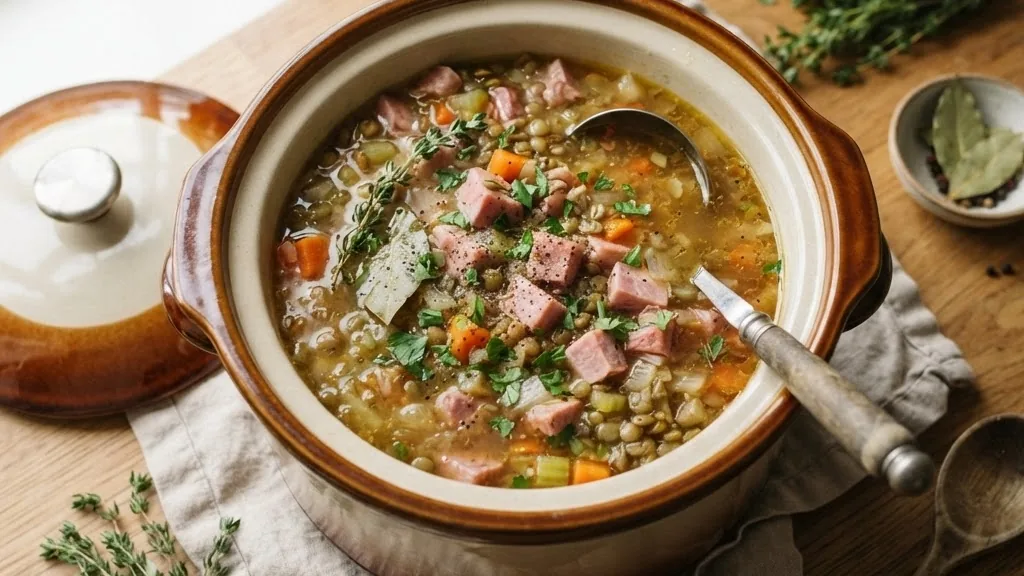
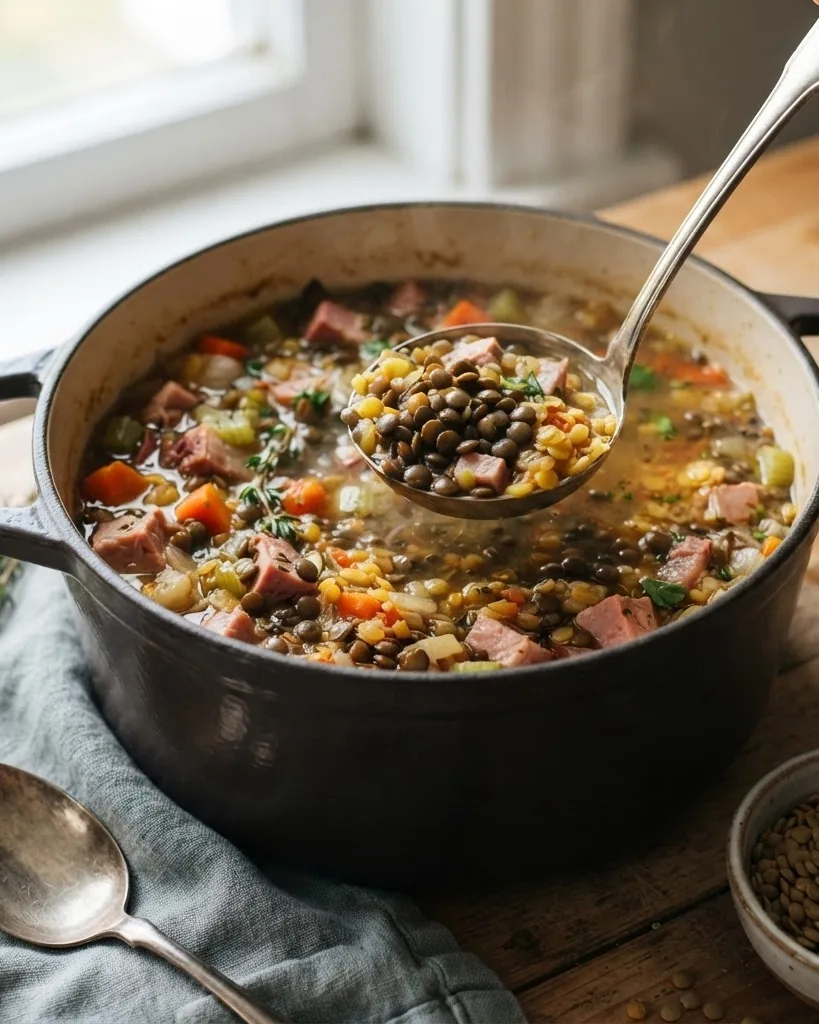
A solid ham and lentil soup starts with one cup of dried green or brown lentils, a smoked ham bone or two cups of diced cooked ham, a classic mirepoix of onion, carrot, and celery, garlic, a bay leaf, and enough low-sodium broth to cover by an inch or two. That is the whole architecture. The lentils thicken the pot as they release starch, the ham carries the smoke, and the aromatics do the quiet work underneath while everything simmers unattended.
Crock size matters more than people expect, and it is one of the few places the leading recipes actually disagree. Betty Crocker calls for a 5 to 6 quart cooker built around a whole ham shank, which takes up real volume before the vegetables even go in. Flour On My Face runs a larger 6 to 7 quart model to accommodate a fuller batch meant for leftovers. A 6 quart pot is the safe middle default for most households, since it leaves headroom for the lentils to swell as they absorb broth, and it still fits a standard ham bone without crowding the vegetables against the sides.
Timing splits cleanly by setting, and the spread across recipes tells you something useful: the bigger the piece of ham, the longer the cook.
- LOW: the longer, hands-off setting, per Julia’s Album for diced ham, stretching further in the Betty Crocker version built around a whole shank, and longer still at Flour On My Face for a fuller crock.
- HIGH: the faster route when you started late or are working with pre-diced ham rather than a bone.
Your doneness cue is texture, not the clock. Pull the lid when the lentils are tender but still hold their shape and the broth has thickened on its own from released starch. If the broth still looks thin and watery at the scheduled time, that is a sign the lentils have not fully broken down their starch yet, not necessarily that they are undercooked; give it more time on the same setting before adjusting anything else. If you want a starchy side to round out the meal, these crispy grilled potatoes as a side pair well with a smoky bowl.
Choosing Lentils: Which Variety Holds and Which Falls Apart
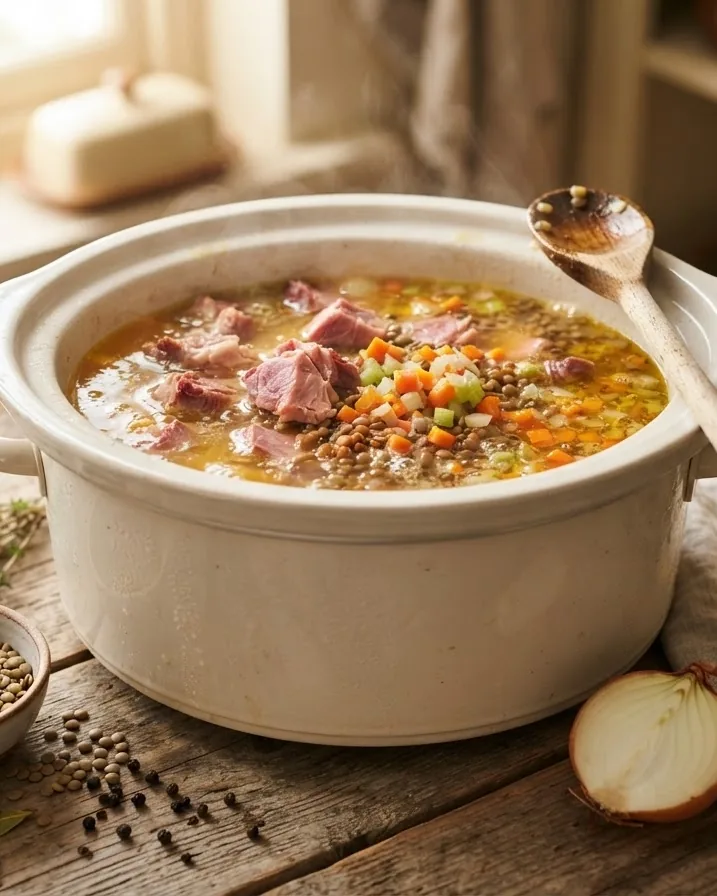
Lentil choice decides the entire texture of the finished soup, and it is the single fastest fix for a pot that came out wrong. Green, brown, and Puy lentils hold their shape through a long slow cook, which is exactly what you want in a brothy soup with distinct bites. Red and yellow lentils break down into a creamy puree, ideal for dal but wrong for a chunky ham soup. None of them need presoaking, which is the key way they differ from dried beans. Rinse and pick through them for stones first, then add them dry straight into the crock alongside everything else.
Here is the practical breakdown by type, useful as a quick reference before you shop:
- Green: firm, slightly peppery, holds shape beautifully across a long cook; the safest default for beginners.
- Brown: the everyday workhorse, mild in flavor and shape-stable in soup, usually the cheapest option at the grocery store.
- Puy (French): small, dark green to near-black, holds its shape tightest of all with a nutty, almost peppery bite; worth the higher price for a special-occasion batch.
- Red or yellow: collapses into a smooth puree as it cooks, best reserved for creamy dal-style dishes rather than this soup.
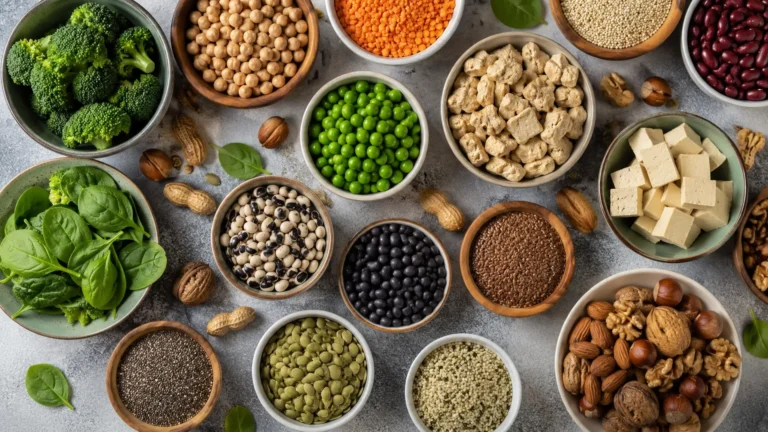
Because dried lentils cook straight from the bag, there is no overnight soak and no separate boil before they go in the crock. That convenience is exactly why dump-and-go works here when the same shortcut would fail with kidney beans, which need a full presoak or they stay tough and can even carry a natural toxin if undercooked. Lentils carry none of that risk, which is part of why they are such a forgiving pulse for a slow cooker. For a look at how other pulses behave in the kitchen, this rundown of high-protein recipes covers legumes across several dishes.
Working With Ham: Bones, Dice, and the Salt Problem
The ham is the true differentiator of this dish, and cured ham brings a salt load that will sink an inexperienced cook who seasons early. You have three formats to choose from, and each changes the flavor and the workflow. A smoked ham bone or shank gives the deepest flavor because the bone marrow and connective tissue render slowly into the broth over hours: simmer it in the pot for the full cook, then lift it out near the end, shred the meat with a fork, and discard the bone, fat, and rind before returning the shredded meat to the pot. Diced cooked ham is the fastest route and drops straight in with no extra step. Holiday leftovers, including spiral-cut ham, rehydrate nicely in the broth over the long cook and are the reason this soup spikes in searches every winter right after a holiday meal.
The salt problem is real and specific to this dish in particular, because ham is cured with salt as part of its processing, unlike a plain chicken breast or raw beef. The rule is simple: do not add salt at the start of cooking. Taste at the end and adjust from there, once the ham has released its sodium into the broth over the full cook time. Reach for low-sodium or no-salt-added broth so you keep full control of the final number rather than compounding two salty ingredients at once.
Why it matters in figures: one published serving of ham and lentil soup from Flour On My Face carries 832 mg sodium alongside 1101 mg potassium. That sodium comes mostly from the ham, not from any salt you add separately. A ham shank is saltier still than diced ham because of how the curing process concentrates in the bone-in cut, so if you use one, hold back seasoning entirely until you have shredded the meat and tasted the broth. Betty Crocker’s classic build leans on ham shanks precisely for that concentrated, cured depth, accepting the higher sodium as the tradeoff for richer flavor.
Food Safety: The USDA Rules Most Recipes Skip
Food safety is where a ham and lentil soup slow cooker recipe quietly succeeds or fails, and it is the part nearly every top-ranked page ignores entirely. The USDA Food Safety and Inspection Service, known as FSIS, defines the danger zone as 40 to 140 degrees F, the range in which bacteria can double in as little as 20 minutes. A slow cooker is designed to move food through that zone fast enough to stay safe, but only if you help it along. Start on HIGH for the first hour to climb past the risky band quickly, never place frozen meat in the crock since it slows the climb through the danger zone, and thaw ham fully in the refrigerator before it goes in.
Reheating leftovers has its own target, separate from the initial cook. FSIS says to bring soups and sauces to 165 degrees F or a full rolling boil when reheating, and it warns against reheating in the slow cooker itself because the appliance heats too slowly, typically operating between 170 and 280 degrees F once it reaches temperature, which is well above serving heat but slow to get there from a cold start. Reheat on the stovetop instead, where you can watch a thermometer or a rolling boil directly, then transfer the reheated soup back to the crock only to hold it warm for serving guests.
Two habits protect the batch across a long cook:
- Leave the lid alone. Lifting it drops the internal temperature by 10 to 15 degrees F and costs roughly 20 minutes to recover, which adds up fast if you check on the pot repeatedly through the afternoon.
- Cool leftovers fast. Move them to shallow containers rather than one deep pot, and refrigerate promptly once the soup comes off heat.
Ham reheating temperatures depend on the specific product, which trips people up because “ham” covers several different processing paths. A fully cooked ham processed under USDA inspection reheats to 140 degrees F, repackaged cooked ham and leftovers go to 165 degrees F since they have been handled and cut after the original cook, and fresh uncooked ham needs 145 degrees F plus a 3-minute rest before serving. FSIS publishes the details in its Ham and Food Safety fact sheet. For general slow cooker guidance, the University of Minnesota Extension and Colorado State Extension both relay the same USDA doctrine on the danger zone in consumer-facing language. FoodSafety.gov and the CDC reinforce the two-hour cooling window in their own materials aimed at home cooks.
Nutrition Per Serving and How the Lentils Earn Their Keep
The nutrition case for this soup rests on the lentils, and the numbers are strong enough to matter for anyone tracking protein or fiber intake. Per USDA FoodData Central, cooked lentils supply about 9 g protein and roughly 8 g fiber per 100 g, at only 116 kcal per 100 g, which is a lean profile compared to most protein sources of similar weight. Scale that to a standard one-cup portion of about 198 to 200 g and you get around 230 kcal, 18 g protein, 16 g fiber, and 3.3 mg iron. Folate is a standout nutrient in lentils, covering a meaningful share of the Daily Value set by the FDA on its 2000-calorie reference basis, making this soup a meaningful contributor to folate intake in a single bowl.
Dried lentils are even more concentrated before they hit water, at roughly 25 g protein and 353 kcal per 100 g. The cooking process simply spreads those same nutrients across the volume the water adds as the lentils absorb liquid and swell, which is why the cooked figures per 100 g look lower even though nothing has been lost.
For the finished soup, one published serving from Flour On My Face lands at:
- 315 kcal per serving
- 26 g protein, boosted by the ham layered on top of the lentils themselves
- 19 g fiber, well above what most single meals provide
- 832 mg sodium and 1101 mg potassium, the sodium driven almost entirely by the cured ham
That protein figure is the headline: 26 g in a single bowl puts this soup in genuine main-course territory, on par with a modest chicken breast but delivered alongside 19 g of fiber that meat alone never provides. The USA Dry Pea and Lentil Council, which maintains variety and cooking data at Lentils.org, treats pulses like these as a cornerstone protein source for exactly this reason, and nutrition.gov points to legumes for the same combination of protein and fiber in one food. If you want to build meatless meals around the same principle, this guide to cooking tempeh at home covers another high-protein staple worth keeping in rotation.
Alternative Methods, Aromatics, and the Finishing Touches
Not everyone has eight hours, and the same soup adapts to the stovetop and the Instant Pot without losing its character. On the stovetop, simmer the same ingredients in a covered pot over low heat until the lentils are tender, far faster than the slow cooker but requiring you to stay near the kitchen to check it periodically. In an Instant Pot or electric pressure cooker, the pressure cycle collapses the long braise into a fraction of the time, typically landing in the 15 to 20 minute pressurized range plus the time it takes the pot to build and release pressure. The flavor logic stays identical across all three methods: the lentils thicken the broth as they release starch, the ham contributes its smoke and salt, and the aromatics build the floor of flavor underneath everything else.
Aromatics deserve a specific note for long cooking that many recipes gloss over. Dried herbs beat fresh here because they hold up over hours where fresh herbs fade, lose their aroma, and can even turn slightly bitter after simmering for six or more hours. Thyme, rosemary, and oregano are the reliable trio, added early alongside the bay leaf so their oils have time to infuse the whole pot rather than sitting on top of the broth unabsorbed.
The finish is what most home cooks forget, and it is a small step that changes the whole bowl. Two moves lift a flat pot:
- Stir in spinach at the very end for color and a fresh vegetal note, off the heat so it wilts gently without going gray or overcooked and mushy.
- Add acid to wake it up: a splash of apple cider vinegar or lemon juice, which Living Lou rightly flags as the detail most recipes skip entirely, even though a long slow cook flattens brightness that only acid can restore at the end.
Serve it with garlic bread, cornbread, or a sharp salad to cut through the richness of the ham. Because lentils are naturally gluten-free, the whole pot is too, as long as your broth is verified gluten-free as well. Cravings for a warming bowl often start the same way this slow cooker soups collection does, and if you want a creamier cousin for a different night, the Cozy Slow Cooker Chicken Pot Pie Soup runs on the same dump-and-go logic with a dairy-based finish instead. Fans of bright, punchy bowls sometimes cross over to a Marry Me Chicken Soup for a different weeknight mood entirely.
A Worked Example: One Full Cooking Day, Start to Finish
It helps to see the whole process mapped onto a real clock rather than just a range of hours, since that is where most first-time cooks lose confidence. Say you start at 7:00 a.m. on a Sunday with a leftover holiday ham bone. You rinse one cup of green lentils, chop your mirepoix, and load everything into a 6 quart cooker with broth to cover by an inch. You set the cooker to HIGH for the first hour, per the food safety guidance on clearing the danger zone quickly, which brings you to 8:00 a.m.
At 8:00 a.m. you switch the setting to LOW and walk away, resisting the urge to lift the lid. Around 2:00 p.m., six hours after the switch, you check texture: if the lentils are tender but still holding shape and the ham bone shreds easily with a fork, you are near the end. If it needs more time, that is normal within the LOW range these recipes report, so you let it run toward the 3:00 or 4:00 p.m. mark instead. Once done, you pull the bone, shred the meat, discard bone and rind, taste for salt, stir in spinach and a splash of vinegar off the heat, and serve. Any extra goes into shallow containers within two hours to hit the USDA cooling target.
Comparing the Top Approaches Side by Side
Looking at how the most established versions of this recipe differ helps explain why timing and crock size vary so much between sources, and it gives you a sense of which approach fits your own ham cut. None of these differences are contradictions; they reflect different starting ingredients and different batch sizes.
- Diced ham, smaller batch: no bone to manage, fastest path from fridge to bowl.
- Whole ham shank, 5 to 6 quart cooker: LOW 8 to 9 hours, includes the extra step of shredding and discarding bone and rind near the end.
- Larger batch, 6 to 7 quart cooker: sized for leftovers and freezer portions rather than a single meal.
The pattern across all three is consistent: more bone-in ham and more volume both push the cook time longer, while diced ham in a smaller batch finishes fastest. Matching your crock size and ham format to your schedule, rather than defaulting to whichever number you saw first, is the simplest way to avoid either an undercooked pot or an unnecessarily long wait.
Troubleshooting, Storage, and Substitutions
Most problems with this soup trace back to three fixable causes: the wrong lentil, the wrong timing, or salt added too early. If the soup is too thick, thin it with hot broth or water a splash at a time rather than all at once, so you do not overcorrect. If it is too thin, simmer uncovered on HIGH for a stretch to let steam escape and the broth reduce, or mash some of the lentils against the side of the pot to release more starch into the liquid. If the lentils are still hard after the full cook, they are usually old stock, since aged dried lentils resist softening no matter how long they simmer; give them more time on HIGH rather than assuming your recipe or timing was wrong. If it tastes flat at the end, you almost certainly need acid and a pinch of salt at the finish rather than more dried herbs, which mostly affect aroma, not brightness.
Canned lentils can work in a pinch when you are short on time, but add them late, since they are already fully cooked and will turn to mush if they sit in the crock for hours alongside raw ingredients still cooking.
Storage is straightforward and this soup rewards batch cooking on a weekend for the week ahead:
- Refrigerate in shallow containers, cooled promptly as described above.
- Freeze for longer holds; lentil soup freezes and reheats unusually well compared to cream-based soups, since it has no dairy to separate on thawing.
For substitutions, split peas swap in cleanly for a slightly earthier pot with a similar cook time, and a meatless version simply drops the ham and leans harder on smoked paprika and a splash of soy or tamari for savory depth in its place. If you are cooking fully plant-based and want more ideas, this primer on what counts as vegan maps out the whole approach for anyone adjusting this recipe further.
Frequently Asked Questions
Do I need to soak lentils before making this soup?
No. Unlike dried beans, lentils cook straight from the bag with no presoaking required. Just rinse them under cold water and pick through for small stones or debris first. Green and brown lentils hold their shape across a long slow cook, so add them dry at the start and let the crock do the rest of the work over the following hours.
Why is my ham and lentil soup too salty?
Cured ham is heavily salted before it reaches your pot, and a ham shank is saltier still than diced ham. One published serving carries 832 mg sodium mostly from the ham itself. Never salt at the start. Use low-sodium broth, taste after shredding the meat, then adjust seasoning only at the very end of cooking once you know exactly how much salt the ham has already contributed.
Can I reheat the soup in my slow cooker?
No, the USDA Food Safety and Inspection Service advises against it because slow cookers heat too slowly to move food safely through the danger zone from a cold start. Reheat leftovers on the stovetop to 165 degrees F or a full rolling boil, then transfer the soup back to the crock only to hold it warm for serving afterward.
Which lentils are best for slow cooker soup?
Green, brown, and Puy lentils are best because they hold their shape across a long cook, giving distinct bites in a brothy soup rather than a puree. Skip red and yellow lentils here; they break down into a creamy texture that suits dal but turns a chunky ham soup into mush by the end of the cook.
How long does the soup keep, and can I freeze it?
Refrigerate leftovers in shallow containers, cooling them promptly after cooking. This soup also freezes very well, since lentils hold their texture through freezing and reheating far better than potatoes or cream-based soups do. Warm frozen portions on the stovetop to 165 degrees F before serving them to guests or family.
Is ham and lentil soup gluten-free and high in protein?
Yes on both counts, with one caveat. Lentils are naturally gluten-free, so the soup is too as long as your broth contains no gluten or wheat-based additives. Protein runs high: one cup of cooked lentils gives about 18 g protein, and a full serving with ham reaches 26 g, which lands it firmly in main-course territory alongside 19 g of fiber in the same bowl.