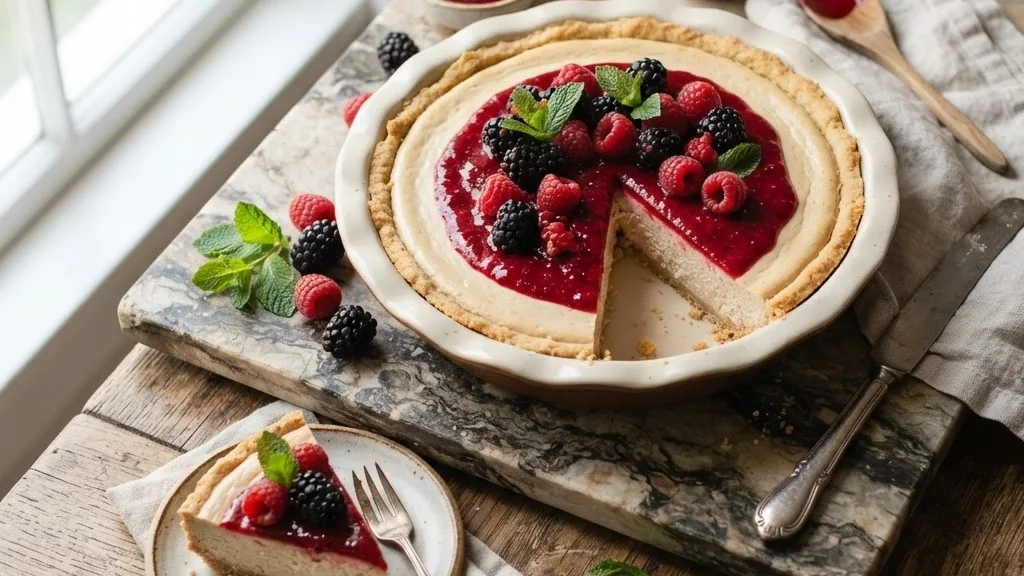
Keto tofu cheesecake -creamcheese sounds like a contradiction until you understand that the tofu, not the dairy, is what makes the dessert work. Silken tofu carries roughly 1 to 2 g net carbs per 100 g, so the block itself is never the reason a keto dessert fails. The two real threats are the sweetener and the crust. Get those right and one slice can land in low single-digit net carbs, well under the limit that keeps you in ketosis.
Get those elements wrong, however, and a supposedly low-carb slice quietly costs you a whole day of carbohydrates. A ketogenic diet requires strict limits to maintain metabolic ketosis. Knowing the math behind your ingredients is the only way to protect that limit.
Quick answer: A keto tofu cheesecake with no cream cheese uses blended silken tofu as the creamy base, an erythritol or allulose sweetener with a glycemic index of 0, and either an almond-flour crust or no crust at all. Built this way, a slice lands in low single-digit net carbs. This rests comfortably inside the 20 to 50 g per day carb ceiling that the National Institutes of Health StatPearls reference uses to define ketosis.
The tofu replaces both the cream cheese and the eggs. It sets through soy-protein coagulation rather than dairy fats. This provides a genuine cheesecake texture without the heavy dairy calorie load, keeping the macro profile clean.
Why Silken Tofu Replaces Cream Cheese Without Losing Texture
Silken tofu replaces cream cheese because it is a neutral, high-moisture protein gel. When processed, it blends to velvet and firms into a sliceable custard. According to the Institute of Food Technologists, silken and soft tofu are made by coagulating soy milk with specific compounds. This process creates a structure that mimics dairy curds without using cow milk.
The science relies on either glucono-delta-lactone heated to roughly 80 to 90 degrees C for 40 to 60 minutes, or calcium sulfate at about 0.25 to 0.4 percent and 70 to 80 degrees C. That gelled soy protein is exactly why blended tofu sets into a dense, cheesecake-like slice rather than staying liquid. There is no dairy chemistry involved, which is what makes the swap honest.
The macros back up the choice entirely. Silken tofu runs about 55 to 62 kcal and roughly 5 g protein per 100 g. A Mori-Nu silken figure listed via Eat This Much shows 62 kcal with 4 g total carbs and about 0.2 g fiber per 100 g equivalent. This leaves immense room in a keto budget.
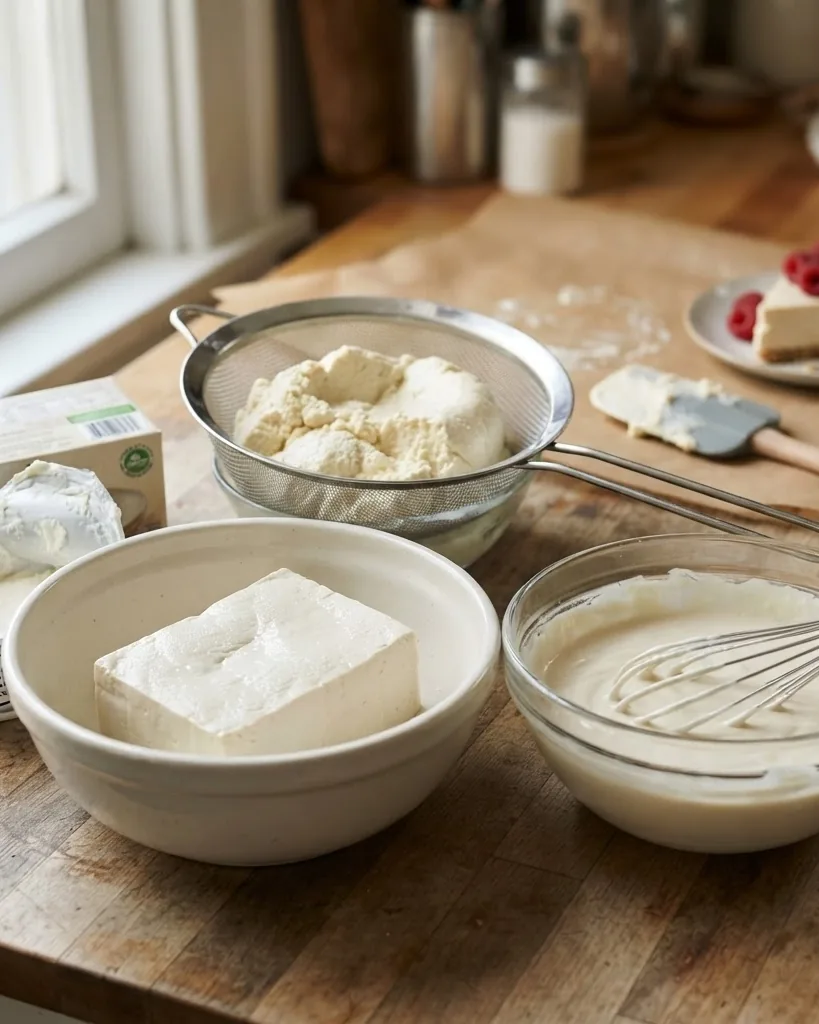
What you buy matters significantly more than the brand name on the box. Firm and extra-firm tofu will not break down properly in a blender or food processor. They stay chunky and grainy no matter how long you run the machine. You must reach for silken or soft tofu for this to work.
- Silken tofu: lowest firmness, blends to a pourable cream, sets smoothest.
- Soft tofu: slightly firmer, still blends well, adds a touch more body.
- Firm/extra-firm: avoid for this dessert; it resists smoothing entirely.
Silken tofu is commonly packaged in a shelf-stable aseptic box or a refrigerated tub labeled specifically as silken. Both work perfectly, provided you drain any standing water before blending.
If you like building silky no-dairy bases for other dishes too, the same neutral-protein logic shows up in creamy plant cooking. For example, our creamy red lentil dhal recipe relies on a starchy legume to do the thickening a dairy fat normally would, showing how plant proteins structure sauces.
The Net Carb Per Slice Math, Shown In Full
The single most useful number for a keto baker is net carbs per slice with the arithmetic visible. Almost no recipe online publishes this complete breakdown. Net carbs mean total carbohydrate minus dietary fiber and minus sugar alcohols such as erythritol that carry a glycemic index of 0.
The U.S. Food and Drug Administration values these keto sweeteners differently than regular sugar. Erythritol is rated at roughly 0.2 cal/g. Allulose is rated at 0.4 cal/g. Below is a worked example for a cheesecake cut into 10 slices, using USDA FoodData Central as the source of truth for each raw ingredient before dividing.
Assume a standard recipe filling of 400 g silken tofu, plus erythritol as the sweetener, plus coconut oil to set the dessert. Silken tofu at about 1 to 2 g net carbs per 100 g gives roughly 4 to 8 g net carbs for the whole 400 g block. Erythritol contributes absolute zero net carbs.
Coconut oil also contributes zero carbohydrates. If you divide the filling total across 10 even slices, the filling alone lands near half a gram of net carbs per slice. This is an incredibly safe margin for a ketogenic diet.
| Component | Whole cake (net carb) | Per slice (of 10) |
|---|---|---|
| Silken tofu, 400 g | 4 to 8 g | 0.4 to 0.8 g |
| Erythritol sweetener | 0 g | 0 g |
| Coconut oil, 100 g | 0 g | 0 g |
| Almond-flour crust | low single digits | ~2 to 4 g |
| Crustless option | 0 g added | 0 g added |
The takeaway writes itself when you look at the table. The crust, not the filling, is where the carbohydrates actually live. A slice with an almond-flour base sits in low single-digit net carbs. A crustless slice is essentially the filling number alone, practically negligible.
Put that against the alternative to understand the keto value. A standard vegan baked cheesecake slice runs about 480 kcal, 54 g carbs and 23 g sugar per serving. That figure is published by Rainbow Nourishments for a conventional dairy-free cake.
That single conventional slice roughly equals a full day’s keto carb allowance under the 20 to 50 g per day threshold. The National Institutes of Health StatPearls reference confirms this strict ceiling. The tofu-and-erythritol build gives you dessert without spending your whole budget.
Sweetener And Crust: The Real Keto Decision Matrix
The keto make-or-break for tofu cheesecake is choosing a sweetener and a crust. That pairing decides both the final carbohydrate load and the mouthfeel. Erythritol, allulose and monk fruit all carry a glycemic index of 0, but they behave quite differently in a blender-set custard.
Erythritol can leave a distinct cooling aftertaste. It can also recrystallize if overdosed in a chilled dessert, leaving a crunchy texture where you want velvet. Allulose stays smoother in cold applications. It also browns just like sugar under heat.
The FDA notes that allulose caramelizes naturally, making it the top pick for a baked, golden top. Monk fruit is intensely sweet and usually sold cut with erythritol. It functions as a sweetness booster more than a bulk sweetener.
Here is how the choices stack up for this specific dessert.
- Erythritol: about 70 percent as sweet as sugar, roughly 0.2 cal/g, zero net carbs. FDA GRAS since around 1997 to 2001, reaffirmed safe by the European Food Safety Authority in 2023. Best all-round no-bake pick.
- Allulose: 0.4 cal/g, about 1:1 sweetness with sugar. FDA GRAS and excluded from Total and Added Sugars on the label since the value was finalized in 2020. Caramelizes well, so best for browned versions.
- Monk fruit: use strictly as a sweetness booster. Verify the blend is not cut with maltodextrin, which adds unwanted carbs.
On safety headroom, erythritol is well tolerated up to roughly 1 g per kg of body weight. The World Health Organization assigns it an Acceptable Daily Intake rated “not specified,” which is the top safety category. That does not mean unlimited consumption is wise, however.
Large single doses of sugar alcohols can cause digestive upset. It is best to spread consumption across distinct servings. Crust choice is the other major lever in your keto math.
Almond flour makes a buttery, sturdy press-in base and carries low single-digit net carbs per slice. Coconut flour is far more absorbent and needs much more fat and liquid to bind, but a little goes a long way. Crustless is the true zero-add option.
To make a crustless version, just press the filling straight into a lined springform pan and chill. For a keto dinner spread where dessert has to close things out, browse ideas alongside these keto dinner ideas so the whole day stays under budget.
If you want a savory, high-fat crunch to serve on the side instead of a sweet crust, there are alternatives. The crackle you get from crispy cinnamon keto pork rinds shows the same almond-flour-adjacent, low-carb texture logic at work in a non-dessert form.
Equipment and Pan Sizing for the Perfect Edge
Choosing the right equipment determines whether your cheesecake sets into a sharp, professional slice or slumps on the plate. A food processor or a high-speed blender is mandatory. Whisking by hand or using a standard stand mixer will not break down the soy proteins enough to create a velvet texture.
High-speed blenders apply enough shear force to liquefy the silken tofu completely. Food processors take slightly longer but require less liquid to keep the blades spinning. Either machine will work, provided you scrape down the sides at least twice during the blend.
Pan choice directly drives the slice geometry. A springform pan releases the cake without requiring you to flip it upside down. This matters tremendously for a soft-set filling that lacks the structural integrity of baked wheat flour.
Always line the base with parchment paper. If you are building a crustless version, parchment is non-negotiable. Without it, the coconut oil or baked tofu will adhere to the metal base, tearing the cake when you try to serve it.
- Springform pan: 6-inch or 8-inch pans work best for 400 g of tofu, yielding a tall slice.
- Parchment paper: Cut a circle exactly the size of the base to prevent sticking.
- Blender tamper: Use this to push the thick tofu mixture into the blades if it stalls.
If you only have a larger 10-inch pan, you must double the recipe. Spreading 400 g of tofu across a 10-inch base creates a flat tart rather than a proper cheesecake slice.
Baked Versus No-Bake: How Each One Sets
Baked and no-bake tofu cheesecakes set through two fundamentally different chemical mechanisms. Picking the right one saves you from a weeping, watery filling. A no-bake version firms strictly because coconut oil or coconut butter solidifies as it chills.
This thermal shift locks the blended tofu into a sliceable block in the refrigerator. A baked version, on the other hand, firms because heat further coagulates the soy protein. This is the exact same reaction the Institute of Food Technologists describes for the coagulants used to make tofu initially.
Both methods can slice cleanly. They just get there by different scientific routes. No-bake wins on speed and overall forgiveness. You simply blend, pour, chill, and you are done.
There is no oven watching, no water baths, and no risk of a cracked top. The no-bake route leans creamier and softer, sitting closer to a chilled mousse-custard. Baked wins on structural integrity and complex browning.
The heat drives off some inherent moisture and tightens the set. This gives you a denser, more traditional New York-style bite. If you use allulose, the surface can take on a real golden color through the Maillard reaction.
- Choose no-bake when you want fast, foolproof preparation and an extra creamy mouthfeel.
- Choose baked when you want a dense, highly sliceable cake with a lightly browned surface.
The tradeoff for the baked version is time and the risk of overbaking. Overcooked tofu protein turns rubbery and releases water, ruining the texture entirely.
Troubleshooting: Beany Taste, Weeping Filling, Grainy Set
The three main reasons people quit making tofu cheesecake are a beany taste, a filling that weeps water, and a grainy texture. Each failure mode has a strict, science-backed fix. Beany flavor comes directly from raw soy compounds present in the tofu.
You can counter this raw note with a pinch of salt, a solid squeeze of fresh lemon juice, and real vanilla extract. Together, these three ingredients mask and round off the raw profile. Weeping or a soft set almost always traces back to the wrong tofu type or an underblended base.
Firm tofu resists coagulating smoothly, and the remaining microscopic chunks trap water that eventually leaks out. Graininess is caused by the exact same firm-tofu problem. The curds never fully break down, leaving a chalky residue on the tongue. Work through the potential failures carefully so that you can save your ingredients.
- Beany taste: add salt, lemon juice and vanilla. The acid and salt suppress the raw soy note without adding meaningful carbs.
- Weeping or won’t firm: use silken tofu, not firm. Blend until fully smooth. Rely on the coconut-oil set for no-bake or a proper coagulating bake for the baked version.
- Grainy texture: switch exclusively to silken or soft tofu. Firm tofu cannot smooth out no matter how long you blend it.
One specific coagulant detail helps when you are at the store. Calcium sulfate, also known as gypsum, yields a softer, slightly sweeter set and adds dietary calcium. Nigari, which is magnesium chloride, reacts faster and is trickier to balance.
If a tofu label lists calcium sulfate as the primary coagulant, it tends to blend smoothest for this dessert. That is a small edge, but it separates a velvet slice from a chalky one.
For dialing in gentle sweetness and aroma, the flavor-masking trick rewards restraint. The tasting notes explored in this work on coffee science show how small variables shift perceived flavor. Vanilla plus acid works on tofu the exact same way.
Common Keto Swaps That Fail in This Recipe
Because traditional cheesecake is heavy on dairy, keto bakers often try to force dairy replacements into this tofu framework. Adding heavy cream or liquid keto sweeteners to a tofu base will cause the emulsion to break. The water content in silken tofu does not mix well with pure liquid fats unless an emulsifier is present.
Liquid stevia drops are another common failure point. While they contain zero carbs, they provide no physical bulk. A cheesecake needs the physical mass of granulated erythritol or allulose to help set the structure.
Without bulk sweeteners, a no-bake tofu cake remains too loose. Finally, do not attempt to use vegan cream cheese blocks to “boost” the tofu. Commercial vegan cream cheeses rely on complex starches and gums that often carry hidden carbohydrates, instantly breaking your keto limit.
Flavor Variations And The Allergen Matrix
You can build four reliable, distinct flavors off one master tofu base. Each carries a small, predictable carbohydrate delta. Vanilla New York-style is the plain benchmark, leaning heavily on vanilla, lemon and salt for flavor.
Chocolate folds in unsweetened cocoa powder. This adds a little fiber-rich carb but creates a dense fudge texture. Lemon pushes extra zest and juice for brightness with essentially negligible net carbs. Berry blends in a small amount of crushed raspberries or strawberries.
Berry is the one variation that meaningfully moves the net carb number because natural fruit brings fructose sugar. Keep berry portions strictly limited to stay safely in ketosis.
- Vanilla NY-style: baseline flavor. Lowest carb option. Relies on vanilla, lemon, and salt.
- Chocolate: requires unsweetened cocoa. Causes a small carb bump, but adds useful dietary fiber.
- Lemon: relies on fresh zest and juice. Near-zero added carbs.
- Berry: highest carb delta. Use a very small handful of berries only.
The diet matrix is where this specific dessert genuinely shines. Built entirely with tofu instead of cream cheese and eggs, it is naturally dairy-free and egg-free. Choose an almond-flour crust and it is not nut-free.
Choose a coconut-flour or crustless base, however, and it immediately becomes nut-free too. It is easily gluten-free since there is absolutely no wheat in the filling or the low-carb crusts.
Honesty on soy matters immensely here. Tofu is soy, so this dessert is fundamentally unsafe for anyone with a soy allergy. It also contains isoflavones, which is a neutral nutritional fact rather than a warning.
The Academy of Nutrition and Dietetics is the right body to consult for individualized diabetic or allergy framing. A registered dietitian can confirm whether a given slice fits your specific medical plan. For a citrus-forward dessert idea to rotate in, our sunny lemon poppy seed muffins use the same bright, low-fuss flavor logic in a different format.
Cross-network, if you are cooking around allergens generally, you can learn a lot from savory recipes. A topping like these crispy gluten-free fried onions proves how far you can push texture without wheat. A broader spread of high-protein recipes pairs perfectly well with a protein-rich tofu dessert to round out a day.
Storage, Freezing And Pan Sizing
A tofu cheesecake keeps its rigid structure best when chilled fully before slicing. It also freezes exceptionally cleanly because the coconut-oil set behaves predictably at low temperatures. Refrigerate the finished cake for several hours, ideally overnight.
This long resting period ensures the fat firms up completely and the flavors have time to settle. Slice the cake with a warm, dry knife for clean, professional edges. Wipe the blade between every single cut.
The dessert is a natural candidate for long-term freezing since there is no dairy fat to turn grainy upon thawing. Wrap slices individually in parchment and foil. Thaw them slowly in the fridge rather than at room temperature to avoid a weeping, wet surface.
- Fridge: chill overnight before making the first cut for the firmest possible slice.
- Freezer: wrap per slice. Thaw slowly in the fridge to prevent surface weeping.
- Pan: use a springform pan plus parchment paper, especially for crustless builds.
Always serve it cold, straight from the refrigerator, when the internal set is at its tightest. If left on the counter in a warm room, a no-bake version will eventually soften as the coconut oil approaches its melting point.
Frequently Asked Questions
Does keto tofu cheesecake actually taste like cheesecake?
Yes, when you season it correctly. Blended silken tofu is highly neutral and creamy. The tang of real traditional cheesecake comes from lemon juice, salt and vanilla rather than the dairy itself. Those three ingredients successfully counter the raw soy note that puts people off.
The final texture reads as a dense, chilled custard. It sits very close to a classic New York-style cake, especially in a baked version that tightens the internal protein set through heat.
Is one slice really keto, and can diabetics eat it?
A crustless or almond-flour slice built with tofu and erythritol lands safely in low single-digit net carbs. This is well within the 20 to 50 g per day ceiling the National Institutes of Health StatPearls reference uses for defining ketosis. Erythritol and allulose both carry a glycemic index of 0.
For individual diabetic guidance, the rules are stricter. The Academy of Nutrition and Dietetics highly recommends confirming any dietary changes or new desserts with a registered dietitian to ensure it fits your insulin response.
Why can’t I use firm tofu instead of silken?
Firm and extra-firm tofu simply will not break down in a standard blender. They stay permanently chunky and produce a grainy, weeping filling that ruins the dessert experience. Silken and soft tofu carry significantly more water suspended in a finer protein gel.
Because of this structure, they smooth into velvet. They set cleanly once the coconut oil chills, or when the bake coagulates the soy protein further. This is the exact same reaction the Institute of Food Technologists describes for industrial tofu-making.
What sweetener browns best for a baked version?
Allulose is the best choice because it caramelizes exactly like regular sugar under heat. The U.S. Food and Drug Administration values allulose at 0.4 cal/g with a glycemic index of 0. It has been excluded from Total and Added Sugars on the nutrition label since 2020.
It is, however, still counted in total carbohydrate counts. That unique browning ability gives a baked keto cheesecake a real golden top. Erythritol tends to recrystallize when cooled and cannot match that golden finish reliably.
Is soy in tofu a health concern for this dessert?
Soy itself is not considered a general health concern for the broader public, though this dessert is unsafe for anyone with a confirmed soy allergy since tofu is made entirely from soybeans. Tofu naturally contains isoflavones, which is just a neutral nutritional fact rather than a danger.
If you have specific medical questions about soy consumption, standard advice applies. The Academy of Nutrition and Dietetics points people toward a registered dietitian for individualized advice rather than relying on blanket internet rules.
How do I stop the beany tofu flavor entirely?
Hit the raw mixture with a pinch of salt, a generous squeeze of fresh lemon juice, and real vanilla extract before blending. The salt and acid physically suppress the raw soy compounds responsible for the beany note. The vanilla extract rounds out the finish on the palate.
None of these additions add any meaningful carbs to the math. Your net-carb-per-slice number barely moves, while the flavor shifts dramatically from raw soy paste to genuine cheesecake tang.
To finish a dinner party, round out the dessert table with a fresh contrast. Serving something like our vegan Nutella ice cream alongside the cake provides an option for anyone at the gathering who is not counting carbs. This ensures one strict dessert build never has to please everyone at once.