Drafted with AI language models. How this page was made
The reason published numbers for lentil soup scatter so widely is that each one measures a different soup. Before trusting any single figure for lentil soup nutrition data, match it to your portion and preparation. The spread below comes from U.S. Department of Agriculture records and registered-dietitian recipe analyses, each kept at its own definition rather than averaged into a false single answer.
The short answer: a cup of homemade lentil soup lands between 151 and 186 calories, carrying 9 to 12 grams of protein and 7 to 9.4 grams of fiber. Plant-based versions contain 0 mg cholesterol. Sodium is the number that moves most: 248 mg per cup in a low-sodium homemade pot versus 800 to 1200 mg in many canned versions. The calorie and protein figures stay stable; sodium is set by how the soup is made, not by the lentils.
Hearty lentil soup: what the registered-dietitian analysis reports
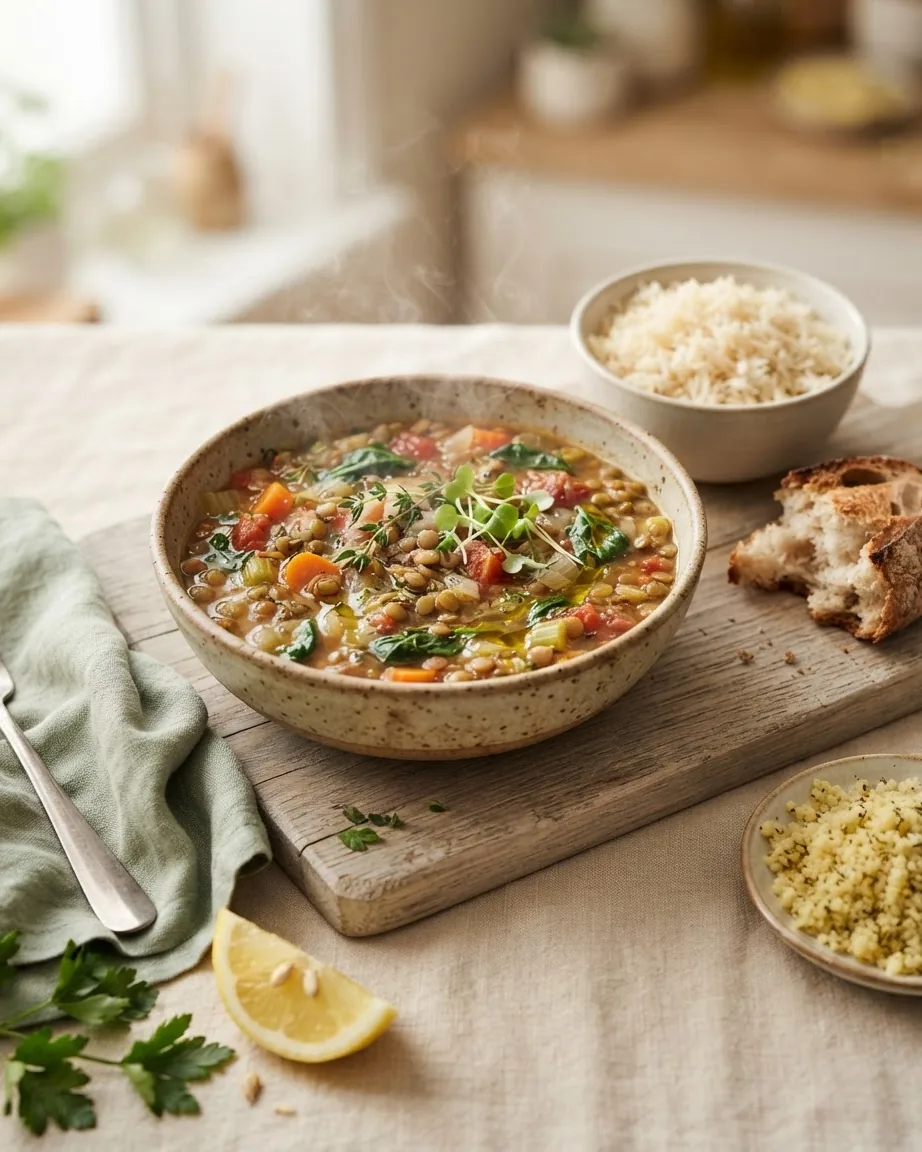
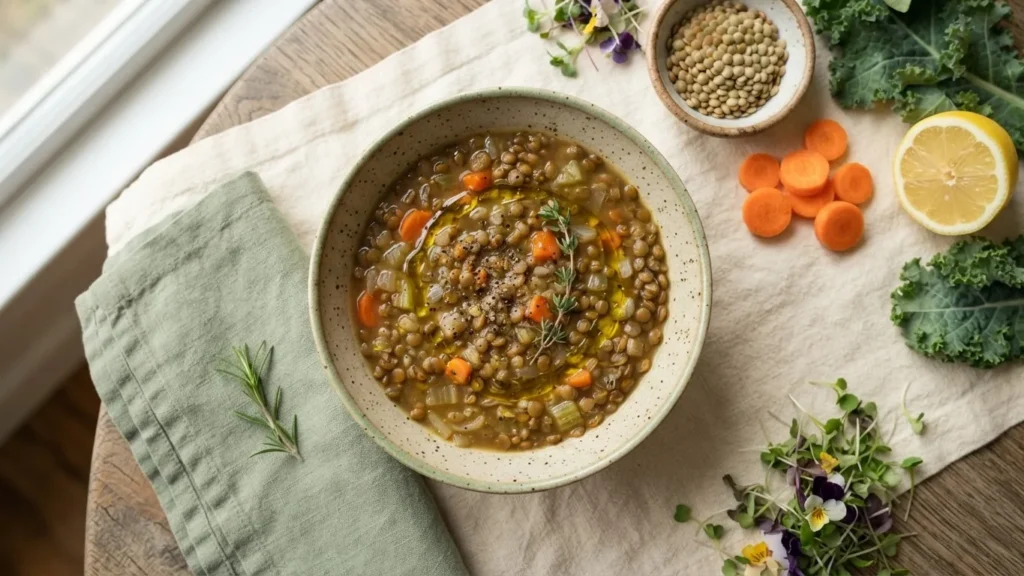
The hearty, meatless version analyzed by Heather Mangieri, RDN, is built at a 1⅓-cup serving, which is why its totals run higher than a flat one-cup entry. Per serving it carries 320 calories, 52 g carbohydrates, 10 g fiber, 18 g protein, 5 g fat, 0.5 g saturated fat, 0 mg cholesterol, and 650 mg sodium, as listed on the hearty lentil soup recipe.
Read that 18 g of protein against the portion before comparing it to a one-cup figure. The serving is a third larger than a cup, so the per-cup protein is closer to the 9 to 12 g range other records show. The 0 mg cholesterol is the signal that matters for a plant-based kitchen: it confirms the recipe uses no meat, unlike the headline USDA record discussed below.
What makes this build hearty rather than thin is the ratio of lentils to liquid and the long simmer that lets starch leach out and thicken the pot. Lentils are rich in lysine but low in methionine, which leaves them an incomplete protein on their own, according to NutriScan’s lentil soup nutrition page. Pairing the bowl with a grain (rice, bread, or a side of couscous) supplies the missing amino acid. For a grain-forward companion, see our zesty garlic tomato lentil salad.
NutriScore by health goal: which number serves your diet
Different eaters need different lines from the same label. Use the figure that answers your actual goal:
- Weight management: the low-sodium homemade cup carries 7 g fiber, which delivers satiety for the calorie cost. A generic cup lands at 186 calories.
- Blood-pressure control: choose preparation by sodium (248 mg per cup homemade versus 800 to 1200 mg canned).
- Heart health: plant-based recipes read 0 mg cholesterol; a glycemic index of 44 is reported by FoodStruct.
- Iron and folate needs: NutriScan reports 3.3 mg iron and 180 mcg folate per 248 g cup.
Vitamin and mineral coverage, cup by cup
Iron and folate per cup appear in only one consumer record alongside the USDA’s per-100-gram “with ham” figures, so the per-cup minerals below come from NutriScan’s homemade entry. One cup (248 g) supplies 3.3 mg iron and 180 mcg folate, as stated on the NutriScan lentil soup page. The USDA SR Legacy record for canned “lentil with ham” lists far lower density per 100 g: 1.07 mg iron and 20 mcg folate, published by the U.S. Department of Agriculture, Agricultural Research Service in food record 171549.
The gap is large because the two records describe different soups at different weights: a dense homemade cup versus a diluted canned product per 100 g. Do not merge them into one vitamin claim; cite the one that matches the soup you are eating.
Mineral density, relative to the plate
Among lentil soup’s minerals, sodium is the one that dominates the label. FoodStruct profiles sodium prominently on its per-100-gram profile. Iron trails well behind that share.
For other plant-based pots in this range, see our zesty lemon lentil soup.
Health checks and warning signs worth a clinician
Lentil soup suits most diets, but three groups should read specific numbers before a second bowl. The figures below are general nutrition data, not a diagnosis.
- Kidney-stone or oxalate-restricted diets: lentil soup rates low, at 13.5 mg oxalate per 100 g, per OxalateContent.com. If you have been told to limit oxalate, confirm your personal threshold with the clinician managing your condition before relying on this rating.
- Sodium-restricted or blood-pressure diets: a canned serving can reach 1200 mg sodium, 50% of the Daily Value. If a dietitian or physician set your daily sodium limit, choose the homemade route at 248 mg and verify the per-serving figure with them.
- Possible legume allergy: hives, swelling, or difficulty breathing after eating lentils are not a nutrition question. Stop eating and seek a clinician or emergency care: a recipe page cannot assess an allergic reaction.
General food-safety storage, portion planning, and reaction assessment are three separate things: the first follows the recipe source, the second follows the figures here, and the third belongs to a medical professional.
Progresso lentil soup nutrition facts: read the can, not the average
Canned lentil soups, including shelf brands, fall into the range NutriScan documents for commercial versions: 800 to 1200 mg sodium per serving, or 35 to 50% of the Daily Value, with fewer nutrients from overcooking, per its database entry. Because sodium and nutrient retention vary by product and lot, the printed Nutrition Facts panel on your specific can is the only figure to trust for calories and sodium. Use the 800 to 1200 mg band as the expected ceiling, then confirm against the label.
Where the sources disagree, and which to trust
Here is a synthesis built only from the sourced figures: a comparison that shows why “lentil soup calories” has no single answer. Each row keeps its own food definition and portion; none is converted or averaged.
| Source and food | Portion | Calories | Protein | Fiber | Sodium |
|---|---|---|---|---|---|
| WSU SNAP-Ed / NHLBI, low-sodium homemade | 1 cup | 151 | 9 g | 7 g | 248 mg |
| USDA FNDDS plain (via Measured Plate) | 1 cup | 153 | 9.7 g | 9.4 g | 622 mg |
| NutriScan, generic homemade | 1 cup (248 g) | 180 | 12 g | 8 g | |
| FatSecret, generic | 1 cup | 186 | 10.42 g | ||
| Heather Mangieri, RDN, meatless | 1⅓ cup | 320 | 18 g | 10 g | 650 mg |
The honest reading: calories per cup cluster between 151 and 186 once you hold the portion steady, and the 320-calorie figure is high only because it measures a third more soup. Fiber ranges from 7 g to 9.4 g per cup for the same reason: different food definitions, not a real contradiction. Washington State University SNAP-Ed, adapting NHLBI, notes that “a serving of cooked lentils is 15.5 grams of total fiber,” on its Live Well lentil soup page: against daily needs of 25 g for women and 38 g for men.
How many calories are in a cup of lentils, and the soup around them
For the soup specifically, a cup runs 151 to 186 calories depending on recipe, while NutriScan’s homemade cup reads 180 kcal. A cup of that soup also carries 25 g carbs, of which 8 g is fiber, leaving 17 g net carbs: lower than a slice of white bread, per the same record. The USDA’s canned “with ham” entry, by contrast, lists only 56 kcal per 100 g: a per-weight figure for a diluted, meat-containing product, not a per-cup homemade value, so it belongs to a different question entirely.
How to prepare lentil soup so the numbers hold
The nutrition figures above describe soup made a particular way, so the method matters. In the low-sodium approach that lands a cup at 248 mg sodium, the sequence that keeps the figures intact is:
- Soften the aromatics first: the WSU SNAP-Ed method sautés carrots and onion until tender, roughly 5 minutes, which develops flavor without added salt that would raise the 248 mg sodium figure.
- Add lentils, tomatoes, broth, and water, then simmer until the liquid thickens, about 30 minutes: the stage where starch leaves the lentils and bodies the soup.
- Rest with the lid on for a final 5 minutes so the lentils finish softening in retained heat.
Using water and low-sodium broth rather than canned stock is what separates the 248 mg homemade cup from the 800 to 1200 mg canned band. The full ingredient list and quantities sit on the WSU SNAP-Ed recipe. For our own stovetop version, see the hearty vegan lentil soup.
The 320-Calorie Bowl, Normalized to One Cup
The hearty meatless recipe looks like an outlier at 320 calories, but it is served at 1⅓ cups: a third larger than every other record on this page. Since 1⅓ cups equals four-thirds of a cup, multiplying each figure by three-quarters puts it on the same one-cup footing as the rest, and the gap closes.
- Calories: 320 × 3/4 = 240 kcal per cup. Lower than the headline number because the difference is purely the extra third of a cup, not a richer soup.
- Protein: 18 g × 3/4 = 13.5 g per cup, landing right beside the 9-12 g other one-cup records report rather than towering over them.
- Fiber: 10 g × 3/4 = 7.5 g per cup, squarely inside the 7-9.4 g per-cup band the table already shows.
- Sodium: 650 mg × 3/4 ≈ 488 mg per cup, roughly double the 248 mg low-sodium homemade cup but still far under the canned range.
Normalized to a cup, the “320-calorie” recipe is not a contradiction at all: it is an ordinary homemade bowl measured in a bigger scoop.
Frequently asked questions about lentil soup nutrition
Is lentil soup fattening?
No. The fiber slows digestion and adds fullness for the calorie cost, which is the opposite of calorie-dense. A meat-free recipe also reads 0.5 g saturated fat per larger serving.
Is lentil soup good for cholesterol?
Plant-based lentil soup contains 0 mg cholesterol, since cholesterol comes only from animal foods. The USDA “with ham” canned record is the exception, carrying 3 mg per 100 g because it includes meat. Choosing a meatless pot, rather than that canned version, keeps the bowl cholesterol-free.
Is lentil soup good for digestion?
Its fiber load is the reason it is often recommended. One cooked-lentil serving supplies 15.5 g total fiber, a large share of the 25 g women and 38 g men need daily, and a soup cup delivers 7 to 9.4 g. Fiber of that volume supports regularity; introduce it gradually if your current intake is low.
How to add protein to lentil soup?
Lentils are high in lysine but low in methionine, so the soup is an incomplete protein alone. Pairing the bowl with a grain supplies the missing amino acid and lifts the meal above the 9 to 12 g the soup itself provides per cup. A larger meatless build already reaches 18 g per serving.
How much water for lentil soup?
Liquid volume sets the final texture rather than the calorie count, since water adds none. In the low-sodium method, the pot simmers until the liquid thickens over about 30 minutes, then rests 5 minutes. Use water plus low-sodium broth instead of salted stock to hold the cup near 248 mg sodium.
Is lentil soup good for high blood pressure?
Only the right preparation is. A homemade cup at 248 mg sodium fits a blood-pressure-conscious plan, but canned versions can reach 1200 mg (50% of the Daily Value) in a single serving. The lentils themselves are not the issue; added salt during processing is, so read the can or cook from scratch.