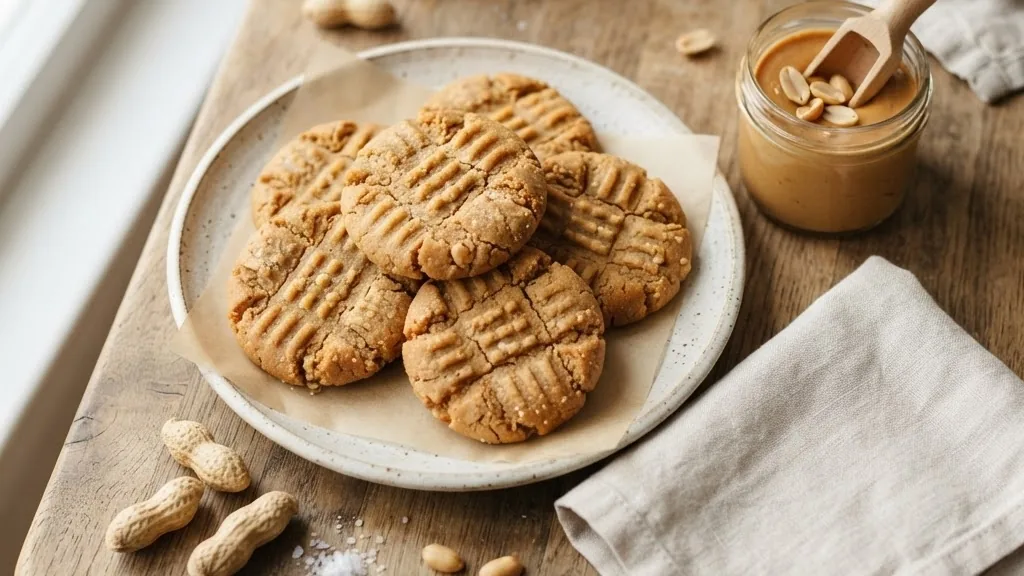
These vegan peanut butter cookies are the recipe I make when I want something in my hand within half an hour and I refuse to run to the store. There is no egg, no dairy butter, and no fancy equipment, just peanut butter doing most of the work and a simple flax egg holding everything together. They bake up soft in the middle with crisp edges and that classic fork-pressed crosshatch, and I have handed them to lifelong omnivores who never once asked what was missing.
The nutrition figures below come from named nutrition authorities and standard food data, not from memory. The recipe is one I have tested and adjusted in my own kitchen.
Quick version: Whisk a flax egg, cream it with peanut butter and brown sugar, stir in a little flour and baking soda, chill the dough for 15 to 30 minutes, roll into balls, press with a fork, and bake at 350 F for 10 to 12 minutes. That is the whole arc. Everything below is the detail that makes them reliable instead of a gamble.
Why these vegan peanut butter cookies work without egg
A traditional peanut butter cookie leans on an egg for structure and a stick of butter for richness. Take the egg out and most people panic, but peanut butter is secretly built for this job. It is dense, fatty, and sticky, so it already behaves like part binder and part fat. That is why some peanut butter cookies get away with only three or four ingredients: the peanut butter is pulling double duty.
The one thing peanut butter cannot do alone is bind the way an egg does, which is where the flax egg comes in. Ground flaxseed stirred into water forms a gel that mimics the way an egg holds a dough together as it bakes. It is the single swap that turns a classic recipe plant-based without changing the flavor. If you want the full menu of egg replacers and when to use each one, I keep a running list in my vegan egg substitute guide, but for these cookies flax is the one I reach for every time.
The result is a cookie that is soft and chewy the day you bake it and still tender the next, with zero dietary cholesterol because there is no egg or dairy in the bowl. The only cholesterol in a standard peanut butter cookie comes from the egg and butter, so removing them removes it entirely. Peanut butter and plant fats carry none.
Ingredients you need
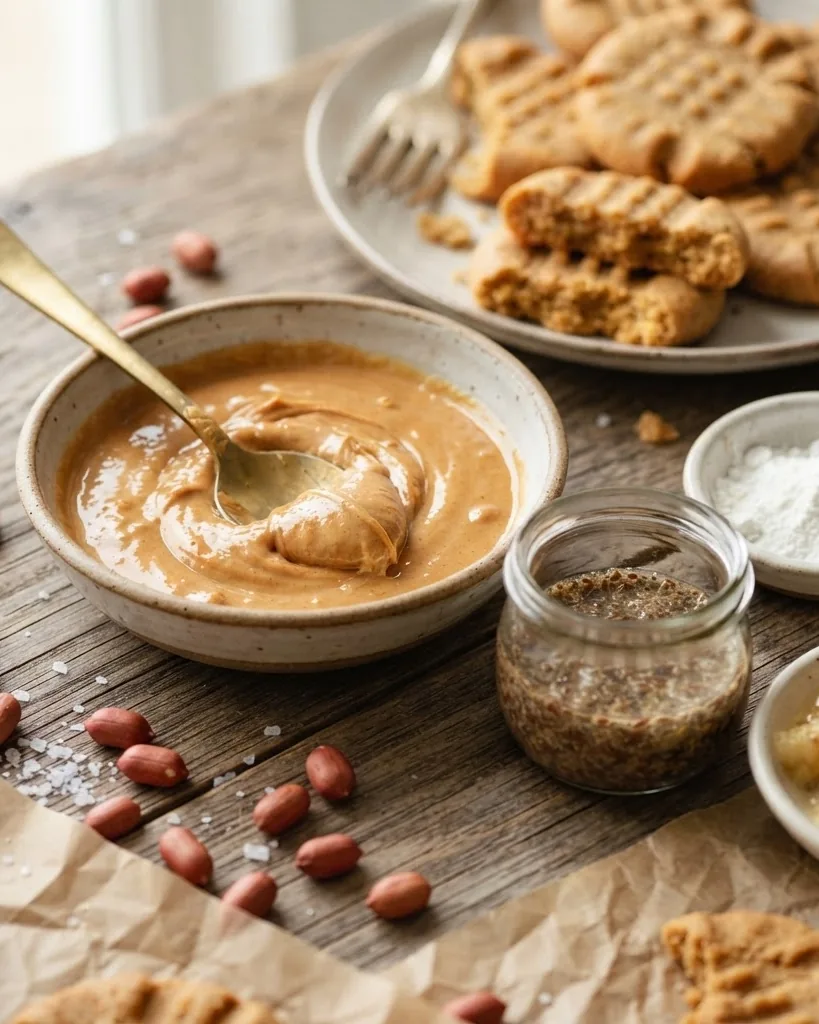
This is a one-bowl, pantry-friendly list. Use natural creamy peanut butter if you can, the kind whose only ingredients are peanuts and maybe salt, because it gives the chewiest result. A no-stir processed peanut butter still works and bakes a touch more uniform.
- 1 cup natural creamy peanut butter, well stirred so the oil is fully mixed back in
- 3/4 cup packed brown sugar, or coconut sugar for a deeper, less sweet cookie
- 1 flax egg: 1 tablespoon ground flaxseed plus 3 tablespoons water
- 1/4 cup all-purpose flour, or oat flour for a gluten-free batch, for a little extra structure
- 1/2 teaspoon baking soda
- 1 teaspoon vanilla extract
- 1/4 teaspoon salt, reduced or skipped if your peanut butter is already salted
- Optional: 2 tablespoons plant milk if the dough feels dry, plus flaky salt to press on top
That is it. No dairy butter, no egg, nothing you cannot find in a basic pantry. The list scales cleanly if you want a double batch, since the flax egg just becomes 2 tablespoons flax to 5 tablespoons water.
How to make the flax egg
The flax egg is the make-or-break step, so give it its five minutes. Stir 1 tablespoon of ground flaxseed into 3 tablespoons of water and let it sit for about 5 minutes. It will thicken into a loose, slightly gloopy gel, roughly the consistency of a raw egg. That gel is what binds the dough, so do not skip the rest time; a flax egg that has not set will not hold the cookie together.
Use ground flaxseed, sometimes sold as flax meal, not whole seeds, because whole seeds will not gel. If you only have whole flax, a quick spin in a spice grinder fixes it. One flax egg replaces one chicken egg, which is exactly what this recipe needs.
Step-by-step method
Read through once, then go. Start to finish is about 30 minutes including the chill, and most of that is hands-off.
- Make the flax egg first: stir 1 tablespoon ground flaxseed with 3 tablespoons water and let it sit 5 minutes while you gather everything else.
- In a bowl, cream together the peanut butter, brown sugar, and vanilla until smooth and glossy. A sturdy spoon is enough; no mixer required.
- Add the flax egg and stir until fully combined. The mixture will loosen slightly and look uniform.
- Add the flour, baking soda, and salt. Stir until a soft, thick dough forms. If it is crumbly and will not come together, add plant milk 1 tablespoon at a time until it does.
- Chill the dough in the bowl for 15 to 30 minutes. This is not optional if you want thick cookies instead of thin, greasy ones.
- Heat the oven to 350 F and line a baking sheet with parchment. Roll the dough into balls of about 1.5 tablespoons each and set them 2 inches apart.
- Press each ball with a fork, then press again at a right angle to make the classic crosshatch. Add a pinch of flaky salt on top if you like.
- Bake at 350 F for 10 to 12 minutes, until the edges are set and lightly golden. The centers will still look soft; that is correct.
- Let the cookies cool on the sheet for 5 to 10 minutes before moving them. They firm up dramatically as they cool, so this rest is what gives you a chewy cookie instead of a fragile one.
A standard batch yields about 12 to 18 cookies depending on how big you roll them. I aim for 15 medium cookies, which is the size the nutrition note below is based on.
The crosshatch and the chill: two texture secrets
Two small steps separate a good peanut butter cookie from a great one, and both are easy to shortchange when you are hungry. The first is the chill. Peanut butter dough is soft and oily, and a warm dough spreads into thin, greasy discs the moment it hits a hot pan. Fifteen to thirty minutes in the fridge firms the fat so the cookies hold a thick, bakery-style shape. I have skipped it in a hurry and regretted it every time.
The second is the crosshatch, and it is not only for looks. Peanut butter cookies do not spread much on their own because the dough is so dense, so pressing them with a fork flattens them to an even thickness that bakes through in the same 10 to 12 minutes. Press once, then again crosswise, dipping the fork in a little sugar if it sticks. You get the signature pattern and a cookie that cooks evenly, which is a nice two-for-one.
Nutrition note
Peanut butter is the nutritional backbone of these cookies, and it earns its place. According to figures from USDA food data and nutrition authorities, 1 tablespoon of peanut butter carries about 94 to 100 calories, roughly 4 grams of plant protein, about 8 grams of mostly monounsaturated fat, and around 3 to 3.5 grams of carbohydrate. It also brings vitamin E, magnesium, and niacin along for the ride, and Healthline’s rundown of peanut butter nutrition lands on the same ballpark figures.
Scaled to this recipe, a single cookie from a batch of 15 lands roughly in the 120 to 150 calorie range, with about 3 grams of protein and 8 to 9 grams of sugar, depending on how large you roll them and which sugar you use. Because there is no egg or dairy, each cookie has zero dietary cholesterol, which is one quiet advantage of the vegan version over the classic. The Harvard T.H. Chan School of Public Health notes that peanuts and peanut butter, eaten in sensible amounts, are linked with heart benefits thanks to their unsaturated fats, so a peanut-forward cookie is a friendlier treat than a purely sugar-and-butter one. It is still a cookie, but it is a cookie with a little something going for it.
Troubleshooting: dry, flat, or crumbly
Most peanut butter cookie problems trace back to the peanut butter itself, because natural jars vary so much in how oily or stiff they are.
- Dough is crumbly and will not hold: your peanut butter is on the stiff, dry side. Add plant milk 1 tablespoon at a time until the dough comes together into a soft ball.
- Cookies bake flat and greasy: the dough was too warm or too oily, or you skipped the chill. Chill the next tray longer and stir 1 to 2 extra tablespoons of flour into the dough.
- Cookies fall apart when warm: they are not fully cooled. These firm up on the sheet, so give them the full 5 to 10 minute rest before you move them.
- Too sweet or not sweet enough: swap brown sugar for coconut sugar to dial it back, or add a touch more if you like a classic sweet cookie.
The single biggest fix for almost everything is using natural drippy peanut butter and respecting the chill. Get those two right and the rest is forgiving.
Swaps and variations
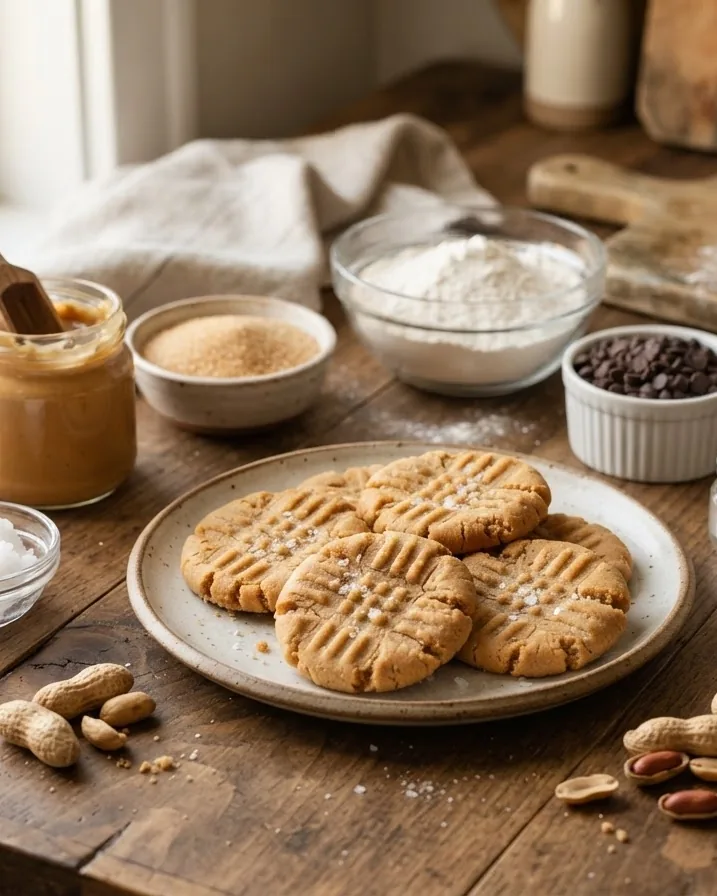
Once the base works, it takes topping and mix-in variations easily. Fold in 1/3 cup of dairy-free chocolate chips for peanut butter chocolate chip cookies. Press a chocolate square into the center the moment they come out of the oven for a molten middle. Swap the peanut butter for almond or sunflower seed butter if you need a peanut-free version, though sunflower butter can react with baking soda and turn slightly green, which is harmless but surprising. For a deeper flavor, brown a little vegan butter and add it with the sugar.
If you are baking your way through a plant-based dessert rotation, these slot in next to anything else in my kitchen. And if peanut butter cookies get you curious about how egg-free baking works across other recipes, that same flax-egg trick carries over to plenty of them, which is exactly why I keep the egg substitute guide bookmarked.
Why natural peanut butter changes everything
If I could give you only one tip for this recipe, it would be about the peanut butter you choose, because it does more to the outcome than any other decision. Natural peanut butter, the kind whose ingredient list is just peanuts and maybe salt, has a loose, oily texture and a deep roasted flavor. It makes the chewiest, most peanut-forward cookie, and it is what I reach for.
Processed no-stir peanut butter, the shelf-stable kind with added palm oil and sugar, behaves differently. It is thicker and more uniform, so it bakes into a slightly more cakey, evenly shaped cookie that spreads a touch less. Neither is wrong, but they are not interchangeable without small adjustments. Natural peanut butter can be runny, so you may need the extra flour or a longer chill to keep the cookies from spreading. Processed peanut butter is stiffer and already contains sugar, so you might pull back the added sugar a hair. The reason your friend’s peanut butter cookies came out different from yours, even with the same recipe, is almost always this: they used a different jar. Once you know which type you have, you can steer the dough to the texture you want instead of hoping it works out.
A quick note on stirring, too. Natural peanut butter separates, with oil pooling on top, and if you bake with the stiff paste from the bottom of the jar without mixing that oil back in, your cookies will be dry and crumbly. Stir the whole jar thoroughly before you measure, or store it upside down so the oil redistributes on its own. It is a tiny habit that quietly fixes a lot of failed batches.
Make-ahead, storage, and freezing
These cookies are built for planning ahead, which is half of why they stay in my rotation. Baked, they keep in an airtight container at room temperature for up to 5 days, staying soft for the first two or three and firming gently after that. A slice of bread tucked in the container helps them hold moisture, an old trick that genuinely works.
The dough freezes even better than the baked cookies. Roll it into balls, freeze them on a tray until solid, then transfer to a bag and keep them for up to three months. When a craving hits, you bake straight from frozen, adding a minute or two to the time, and you get fresh cookies without making a whole batch. This is my favorite move, because two warm cookies on a Tuesday night beats a dozen you feel obligated to finish. You can also freeze the baked cookies themselves and thaw them at room temperature, though the from-frozen dough gives a fresher result.
One planning tip for the crosshatch: press the frozen dough balls before freezing if you want that pattern, because pressing a rock-hard frozen ball will crack it. Shape and mark them soft, then freeze, and they bake up looking exactly like a fresh batch.
Serving ideas and mix-ins
Plain, these cookies are already a complete thought, but they take dressing up well. Here are the variations I actually make:
- Peanut butter chocolate chip: fold in 1/3 cup dairy-free chocolate chips. The classic upgrade, and the one I make most.
- Molten center: press a square of dairy-free dark chocolate into each cookie the moment it leaves the oven for a melty middle.
- Salted and drizzled: flaky salt on top before baking, then a thin drizzle of melted chocolate once cooled. Bakery-window energy.
- Peanut butter sandwich cookies: spread a little jam or dairy-free chocolate between two cookies for a lunchbox treat.
- Ice cream sandwiches: a scoop of dairy-free vanilla between two cooled cookies, then back in the freezer to set.
For serving, a warm cookie with a glass of cold oat or soy milk is the whole experience, and it doubles the protein if you use a fortified soy milk. If you are building a plant-based dessert spread, these sit comfortably next to brownies and cookies of every other kind, and they tend to disappear first because everyone recognizes a peanut butter cookie on sight. They travel well too, holding their shape in a tin, which makes them my default for potlucks and bake sales where nobody needs to know they are vegan until they ask.
One more serving thought worth mentioning: because these cookies lean on peanut butter for their fat and protein rather than a stick of dairy butter, they feel a touch more substantial than a plain sugar cookie, which is why one or two genuinely satisfy. I like them slightly underbaked and still warm, when the center is almost fudgy, but they are equally good the next day at room temperature with a firmer chew. Give a warm one a minute to set before you bite in, because straight out of the oven the middle is delicate and will crumble; that short rest is the difference between a cookie that holds together and a delicious mess. It is a small patience tax that pays off every single time.
Frequently asked questions
Are peanut butter cookies normally vegan?
No. A traditional peanut butter cookie uses egg and often dairy butter, so it is not vegan. This recipe swaps the egg for a flax egg and skips dairy butter, using peanut butter and a little oil or plant milk instead, which keeps the same texture without any animal products.
Can I make these vegan peanut butter cookies without flax?
Yes. Aquafaba, the liquid from a can of chickpeas, works as a binder, using about 3 tablespoons per egg. A mashed ripe banana or 1/4 cup of unsweetened applesauce also binds, though both add a little flavor and moisture. Flax stays neutral, which is why it is my default.
Why did my cookies spread too much?
The dough was too warm or too oily. Peanut butter fat softens fast, so chilling the dough 15 to 30 minutes is essential, and adding 1 to 2 extra tablespoons of flour helps if your peanut butter is very runny. Cold dough holds a thick shape.
How long do I bake vegan peanut butter cookies?
Bake at 350 F for 10 to 12 minutes, until the edges are set and lightly golden. The centers should still look soft when you pull them, since they finish firming as they cool on the sheet. Overbaking is the fastest way to a dry, hard cookie.
Do I need flour in peanut butter cookies?
Not strictly. Three-ingredient versions skip it, relying on peanut butter and sugar alone. But a small amount of flour, about 1/4 cup, gives a sturdier, less fragile cookie that holds the crosshatch better, which is why this recipe includes it. Oat flour works for a gluten-free batch.
How should I store them, and can I freeze the dough?
Store baked cookies in an airtight container at room temperature for up to 5 days. The dough freezes well: roll it into balls, freeze on a tray, then bag them and bake straight from frozen, adding a minute or two to the bake time. Freshly baked from frozen dough is my favorite trick.
Sources: USDA FoodData Central (peanut butter calories, protein, and fat per tablespoon); Healthline (peanut butter nutrition and benefits); Harvard T.H. Chan School of Public Health, The Nutrition Source (peanuts, unsaturated fats, and heart health).